canuks

Saturday, February 18, 2006

Southern Endurance

We had arranged to meet at 10:00 am at the charter office to gain access to our sailboat. We arose a bit early, and spent a half hour re-packing our gear to reduce the amount of stuff we would need to bring onboard.

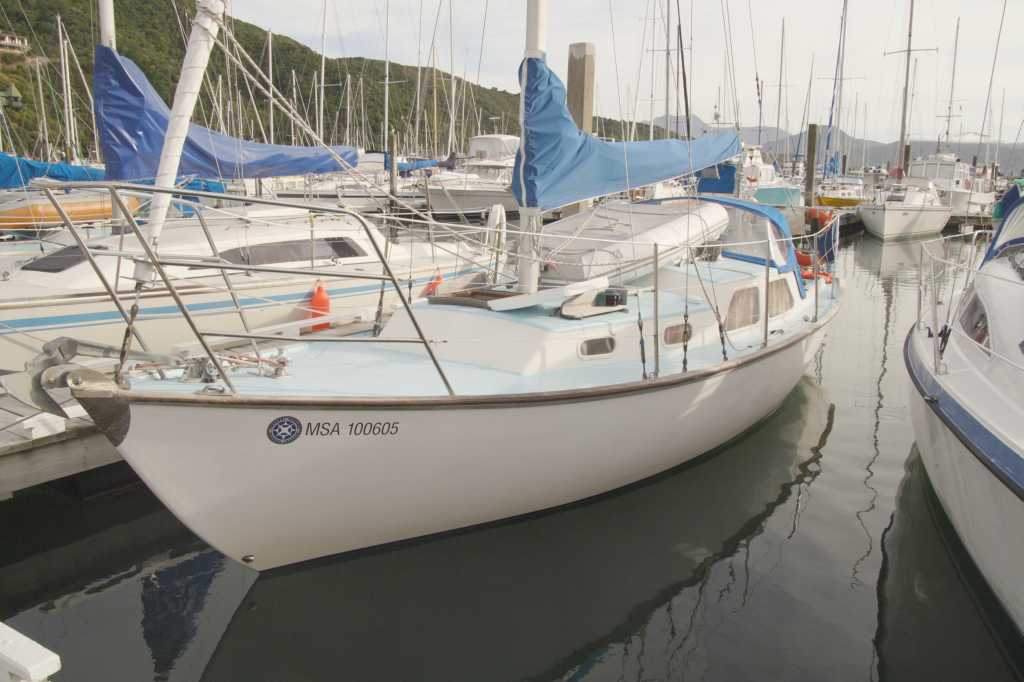
At the charter office, we met up with Crystal, the charter operator, and her small son who took us down to the marina and gave us a tour of Southern Endurance, the sailboat we had booked. We were a little nervous that she would be critical of our limited experience with large-ish boats such as this (for those not familiar, Debbie and I had a 22 foot Tanzer sailboat we sailed on Lake Ontario, so we are not complete novices. There is, however, a significant size and weight difference between a 22 foot (3300 lbs) sailboat and a 29 foot (16000 lbs) sailboat).

Our concerns were unfounded, as Crystal was happy to hand us the keys, give us a complete and detailed tour of the mechanical and electrical issues associated with safe handling of the boat, and then leave us on our own.

After Crystal left, we left the boat and headed into Picton (5-10 minutes) to have breakfast and do some shopping for food and supplies. Once saited and stocked, we spent a little while unpacking our gear into the various lockers of the boat and familiarizing ourselves with the boat's equipment.

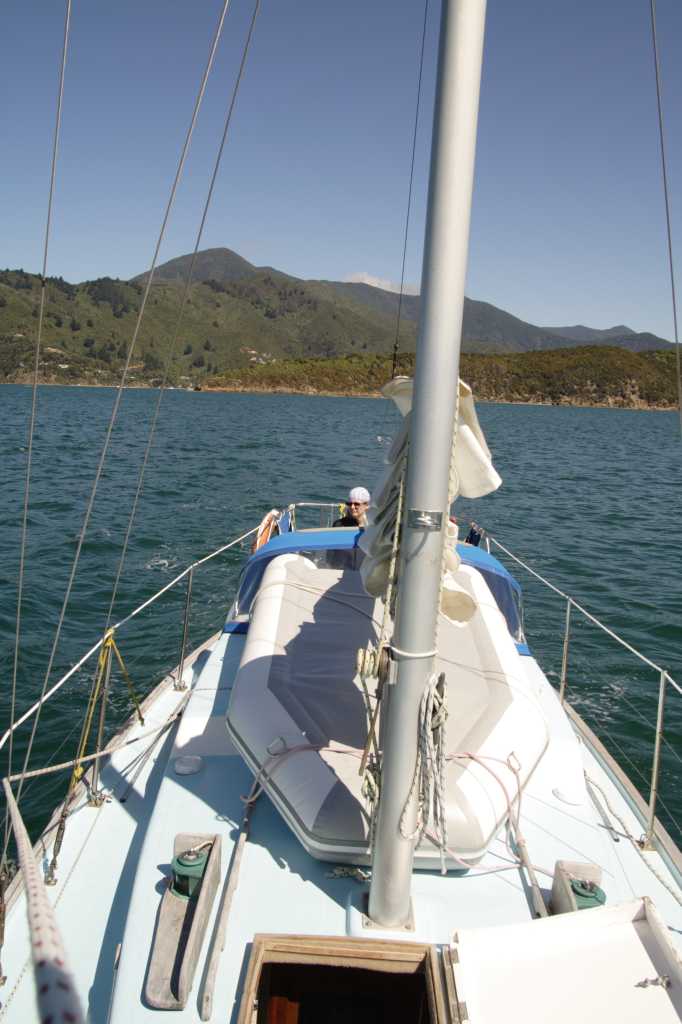
With half the day ahead of us, we decided to go out for a get-acquainted cruise. Our original plan was to just spend a couple of hours motoring around the region and then return. After we were out for a half hour or so, we decided to put out the jib, as the boat had roller furling, and it is extremely easy to put out and take in.

With the jib out, we turned off the engine, and sailed jib only for a while. The wind was pretty stiff, and we were a little anxious about going under full sail, but there were several other boats out under full sail, so we decided to go for it. Crystal had suggested that the mainsail was reefed (shortened) so we thought it might be easier, but it turned out that the main was equipped to be reefed, but was not in fact reefed. When the full main sail was deployed, we had all of our sails fully deployed.

There was some short alarm until we were able to let sails out and spill as much air as necessary to get the boat under a level of heel that felt comfortable to us.

The inital period of mild panic was followed by a couple of hours sailing in fairly stiff winds getting comfortable with the capabilities of Southern Endurance. After a while, we dropped the sails and motored back to our slip.
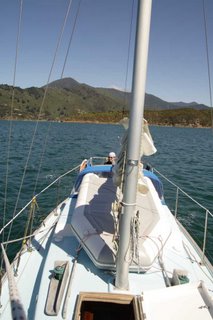

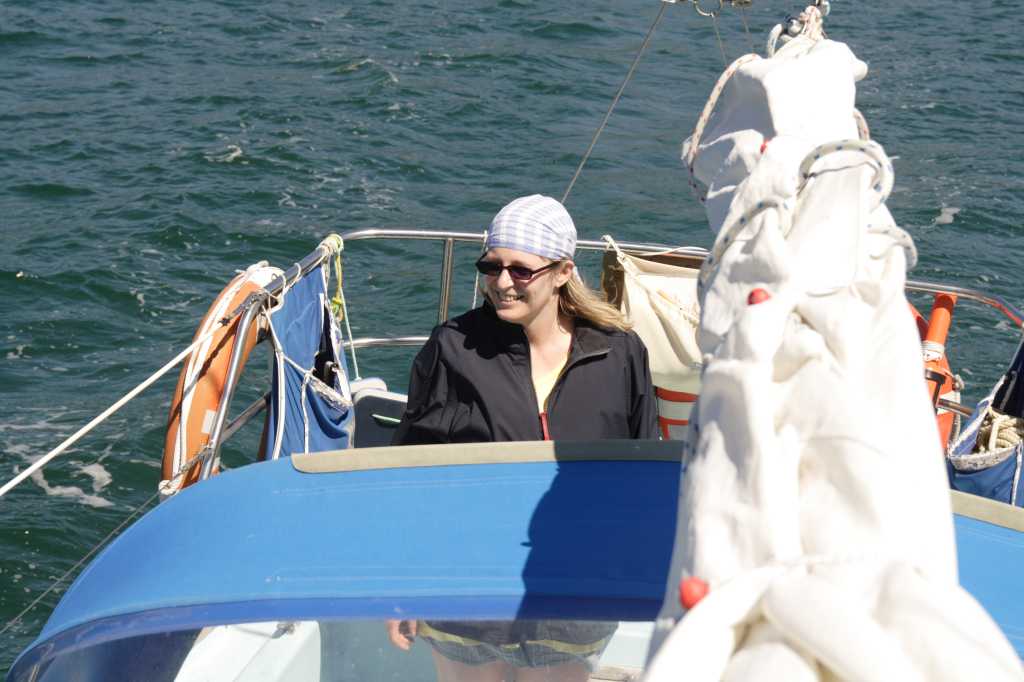
I'm seriously digging the pirate look.
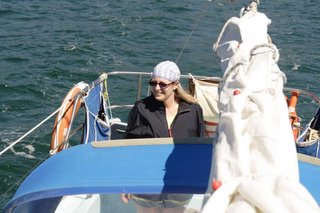

We had noticed a certain "Odeur" about the below decks that we had attributed to the boat having been shut up for a while. After we returned from our sail, we noticed that the smell had not diminished. We closed up the hatches and went into Picton for dinner.

Upon our return, we found the smell was stronger, but after a little while with the hatches open, the odour had receded somewhat. If you are wondering what the smell was, try to remember the last time you were in one of the blue plastic portable toilets they set up for special events. Then picture it sitting out in the sun for a while. Then open the door and take a good snootful.

After a short while, it became abundantly clear that the smell was too much, and so we decided to abandon ship, and to talk to the charter people in the morning. I left Debbie in the stink ship and headed out to Picton in search of a vacant motel room. Although Picton has at least 20 motels there was not one single vacant room available. I returned to the Southern Endurance, and Debbie and I made the best of our situation, and with fully open hatches, got a restless, stink filled, night's sleep.

How will things turn out? Will Debbie and Don choke to death on the evil portapotty fumes, much to the dismay of their friends and family? Wait and see ...

Don

Friday, February 17, 2006

Heading South

Friday was driving day. We had somewhat underestimated the time required to drive from Pukehina to Wellington, where we would catch the ferry to the South Island. Although the distance would suggest (assuming an 80 kph average out of a possible 100 kph maximum) a 5 hour trip, it turns out that there are several road features that trim that average speed below 80 kph.

We had wisely discussed this trip with some locals, and had taken their word for it that it was closer to a 7 hour trip, so with a 5:45 pm checkin time in Wellington, we got on the road at 8:30 am to leave ourselves time for lunch and a little cushion.

The drive from Pukehina to Rotorua we had done twice before and there were no surprises. From Rotorua you head south to Taupo, which is a tourist town based on lake frontage on the quite large freshwater lake (Lake Taupo - go figure). The drive to Taupo, except for getting trapped behind some pokey drivers was uneventful.

This is where the drive became a little surprising (for the driver - read "Harrowing" for Debbie). The road south out of Taupo leads along a very picturesque path following the southern edge of Lake Taupo. Unfortunately, the mountains nearby didn't leave enough room between the mountain and the lake for the road engineers to leave wide lanes, or to take out the sharp hairpin turns. Or to put up sturdy barriers to prevent you from plunging off the edge into the lake.

There are apparently some mountains between Taupo and Wellington. Our road map does not show these, but they are there, and the road winds along between the valleys, with very few passing lanes built.

Just keep in mind that this is Highway #1, the main route from the north of the island to the south of the island ... from Auckland, the largest city, to Wellington, the nation's capital. It completely defies belief how many hairpin corners, rated at 25 kph, there are in this road. I found the constant curves challenging and, as I said, Debbie found it harrowing.

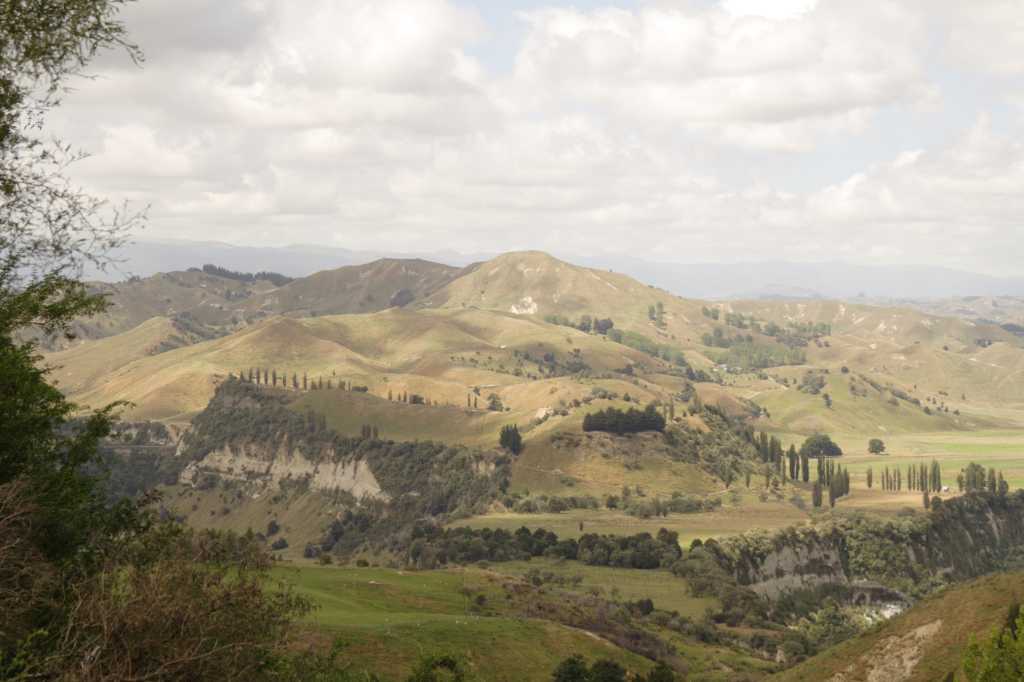
We stopped at one of the scenic rest stops and took a few pics. Here's one.


On the other side of the mountains, the terrain changes abruptly. On the north side, there are lush mixed forests. We drove past the last hill, and found ourselves in a dry terrain, with nary a tree in sight. For those of you who have seen Lord of the Rings, the south side was exactly as you would expect Rohan to be. Low scrub, short grasses, and dry. It was kinda cool to see the sudden change.

The desert terrain lasted an hour or so, and then slowly became more treed and flat. The road south led eventually to the edge of the ocean, at which point the road engineers again adopted the curvy, jerky approach.

The road leading into Wellington proper opens into a 4 lane road, although not exclusively limited access, and leads down through a very impressive cleft between two small mountains before turning into a 4 lane city street.

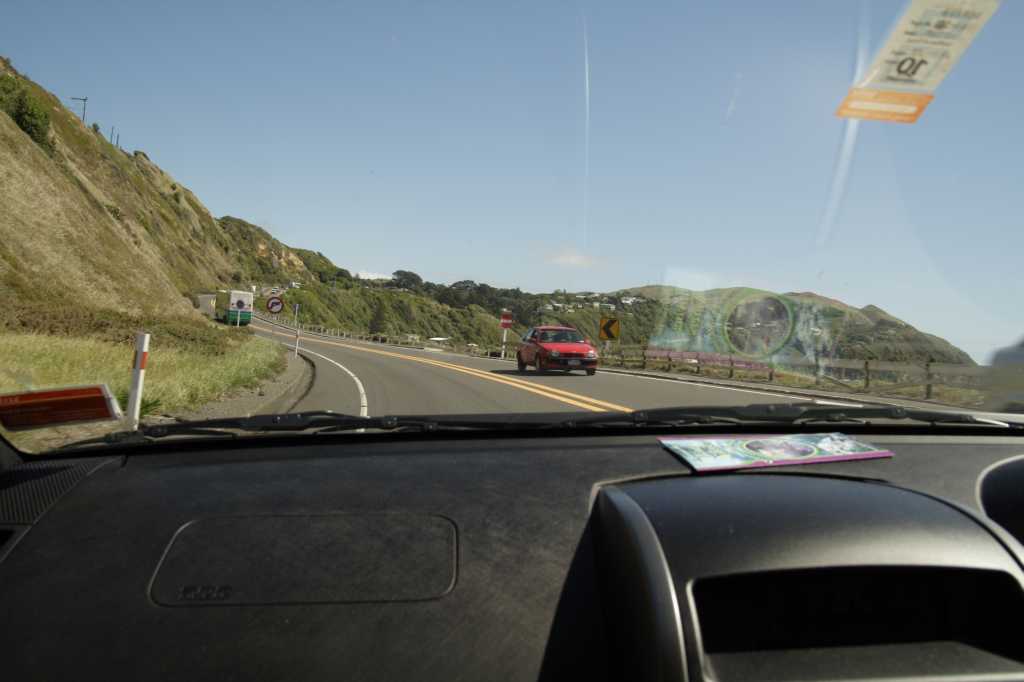
Here is a shot Debbie took as we approached Wellington. Three significant things to notice. One ... I'm driving on the shoulder but not as far as the picture might suggest. Two ... See how sharply the terrain falls off once the road ends. This road has huge shoulders compared to the stuff through the mountains. Three ... Check out the "No Right Turn" sign - seriously, do they think this might be a problem?


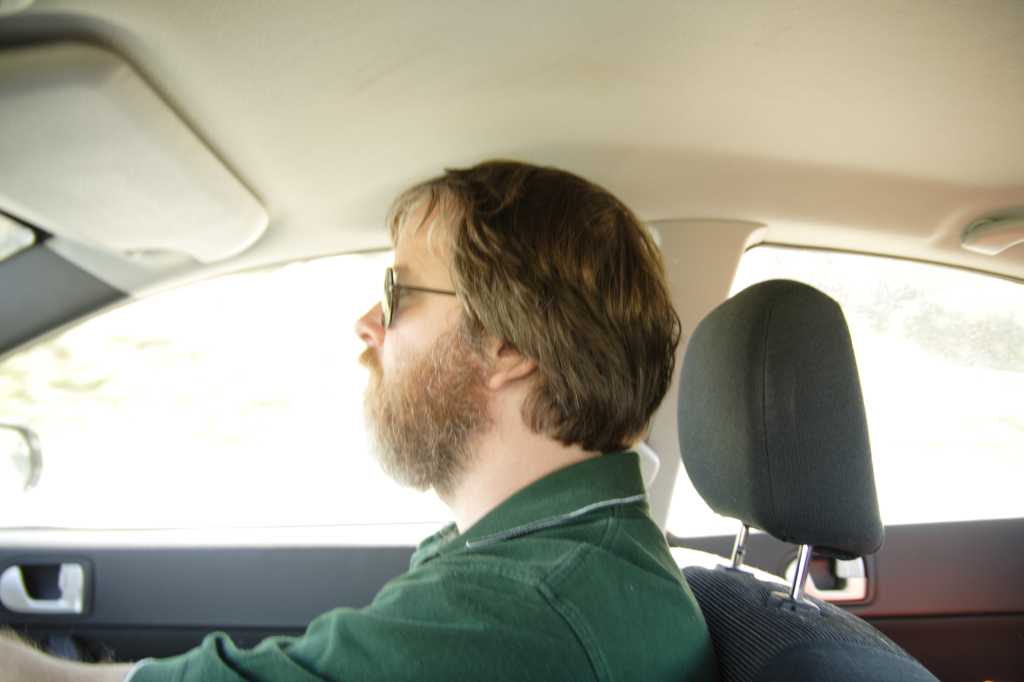
Check out how completely comfortable this guy is driving in this city.


We located the ferry terminal, and because of our early departure, we still had an hour and a bit before we were required to check in. We headed into Wellington to scope out the city a little more closely.

Wellington is a port city and is built around a large protected harbour. We gassed up the car and asked the attendant for directions to any waterfront cafe at which we might while away the last hour before checkin. We followed his advice and drove down toward a public pier. Unfortunately the pier was closed to the public, and we were forced to turn around.

As I executed a 3 point turn, the front bumper caught on a low, protruding wooden barrier, and was mildly, but obviously damaged. We were quite distraught at this as you might imagine. The rental car has a NZ$2100 deductible, so we will be buying a new bumper for this Mitsubishi.

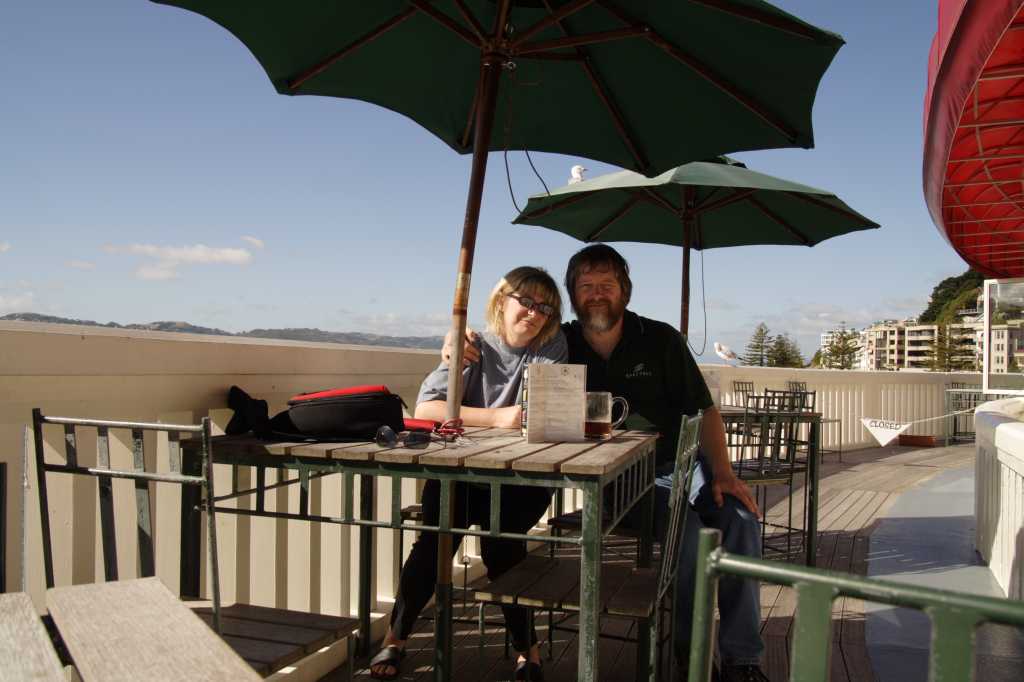
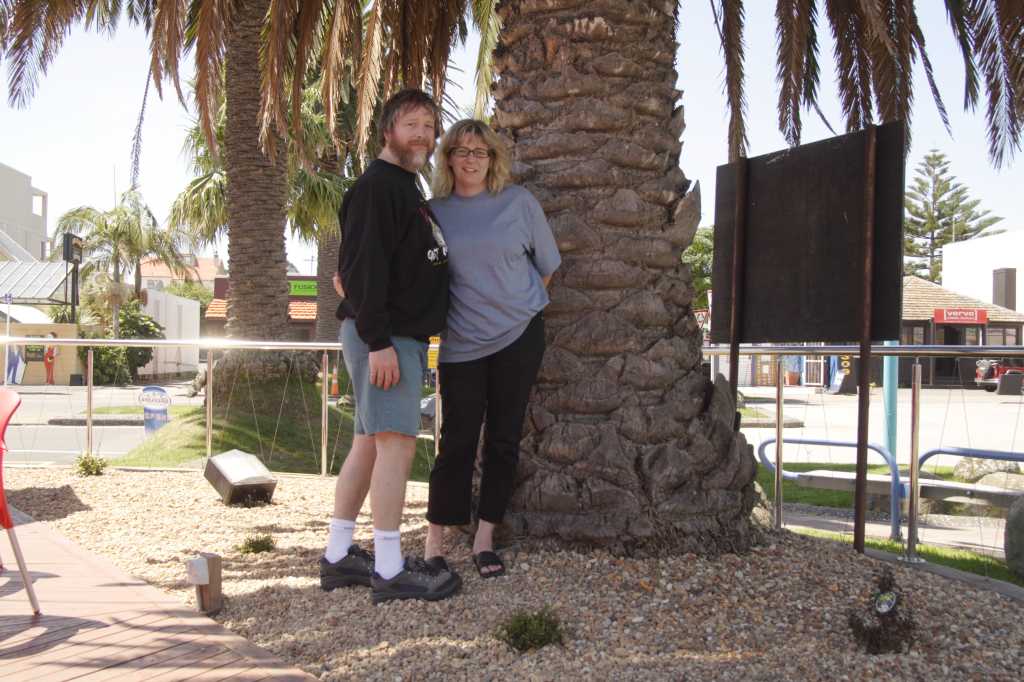
We drove off without further mishap, and stopped at a beachfront cafe to grumble together at our misfortune. Here is a pic of two unhappy campers.


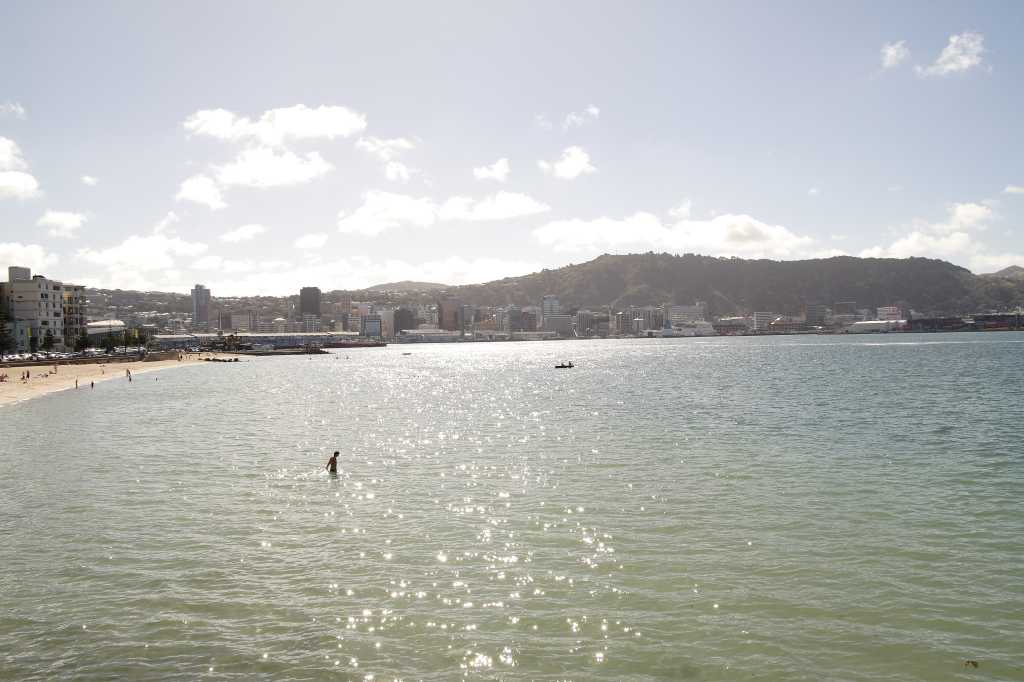
Here is a shot of the Wellington downtown from the same vantage point.


We dropped the rental car off at the Avis outlet attached to the ferry terminal, and after filling out some forms about the accident, packed our luggage off to the ferry check-in. The interisland ferry takes about 3 1/2 hours to get from Wellington on the north island to Picton on the south island. We set ourselves up at a table near the stern rail of the ferry, and with a wave at the north island as it passed away (and a couple of consoling drinks), put the rental car incident behind us.

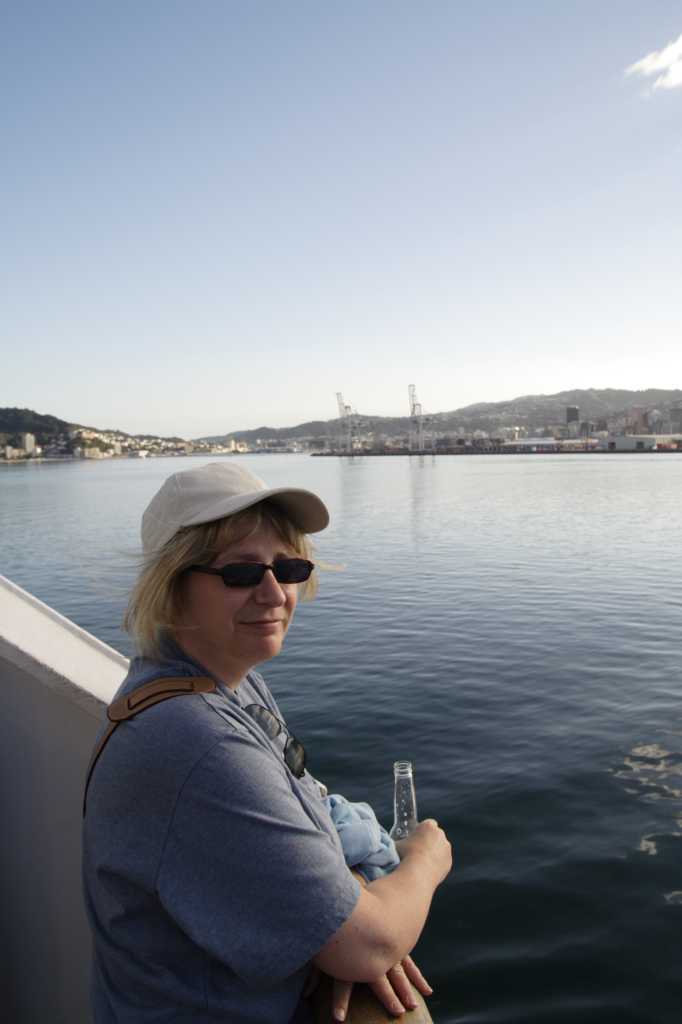
Here's Debbie leaving her troubles, if not her credit card balance, behind.


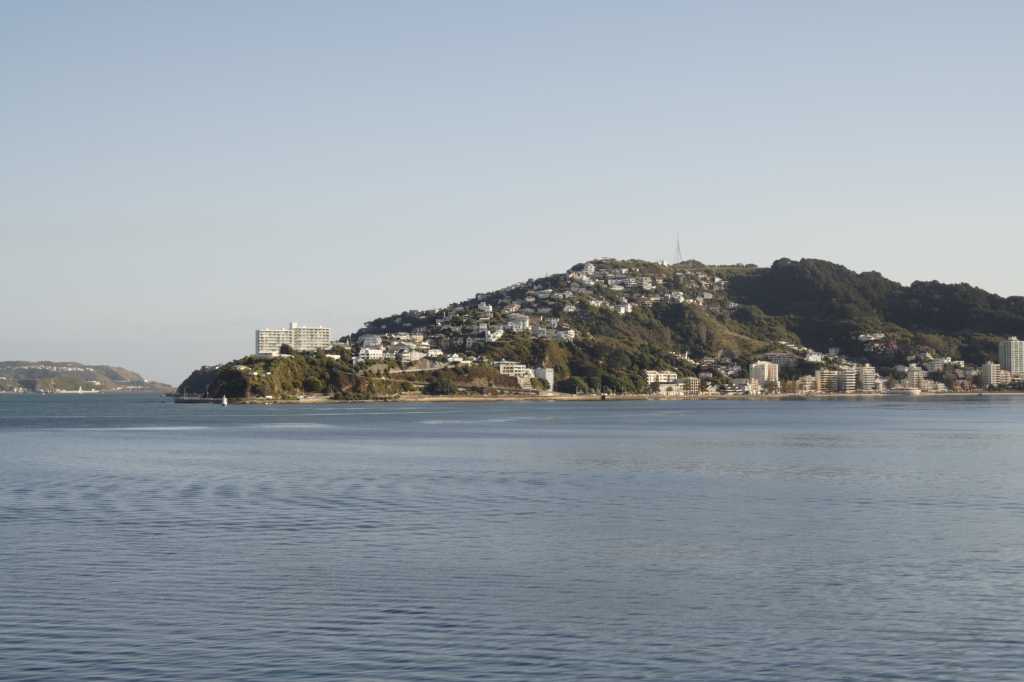
This is a view of a Wellington suberb. Makes Maple seem kinda sad in comparison.


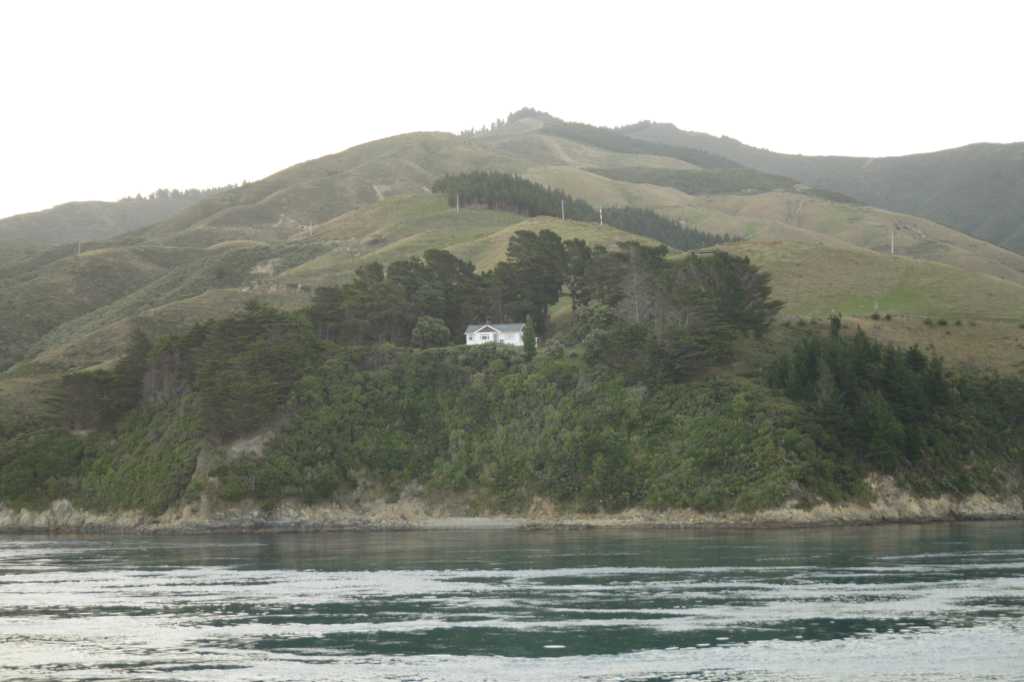
Someone lives here. What they do for a living I couldn't guess unless there's more money in watching ferries go by than I would have supposed.


We picked up our new rental car at the south island ferry terminal, and after our luggage came off the luggage carousel drove to our one night stay at the Americano motel. We have nothing either nice or derogatory to say about the Americano. It was fine.

We found one restaurant out of the 10 or more on the main drag of Picton that would still serve us some dinner, ate, and retired exhausted to our little room (three single beds - that's all that was left).

But Saturday's another day ...

Don

Thursday, February 16, 2006

The Last Lazy Day At Pukehina

We set out on a driving adventure with two important goals Thursday morning: Boat shoes and lunch. We were successful in meeting both goals.

Although we had driven twice now through Tauranga, which is sistered with a town called Mt. Manganui, we had never visited the latter town.

Mt Manganui is a classic summer town except the harbour over which the expensive homes are looking, is a working overseas shipping harbour, so it's a little less scenic than customary. The main street is not next to the water, but is well populated with restaurants and crafty crap/souvenir shops.
We did our main shopping at a genuine shopping mall, complete with Woolworths (groceries only) and a K-Mart (department store) as the anchor stores. A little blast from the retail past for those of us who remember Canadian retail history.

Here are a few pics we took in Mt. Manganui.


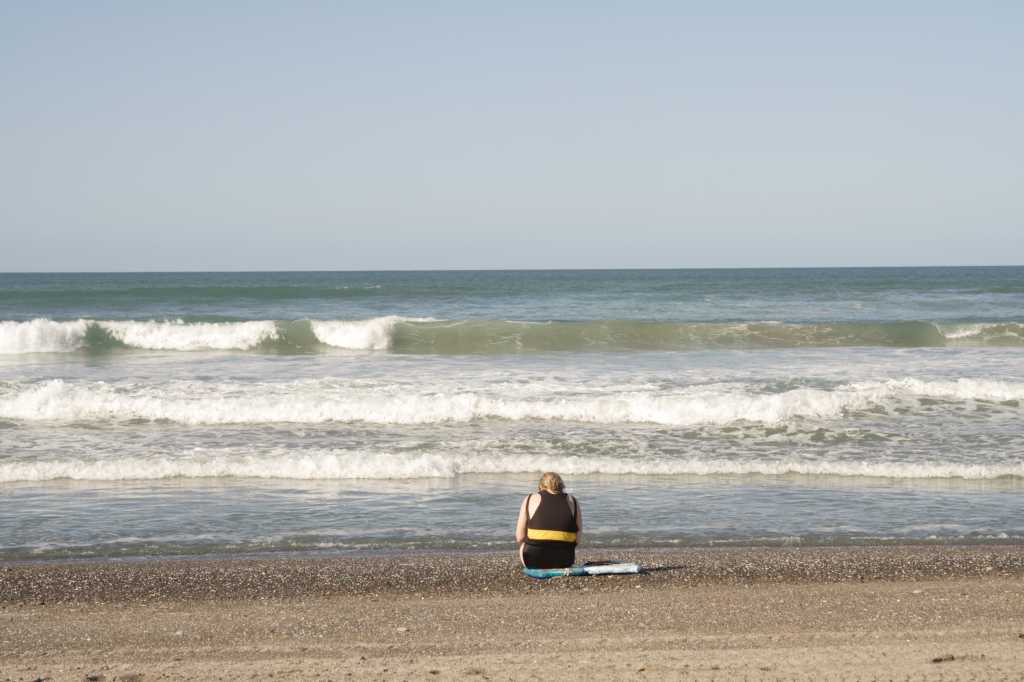
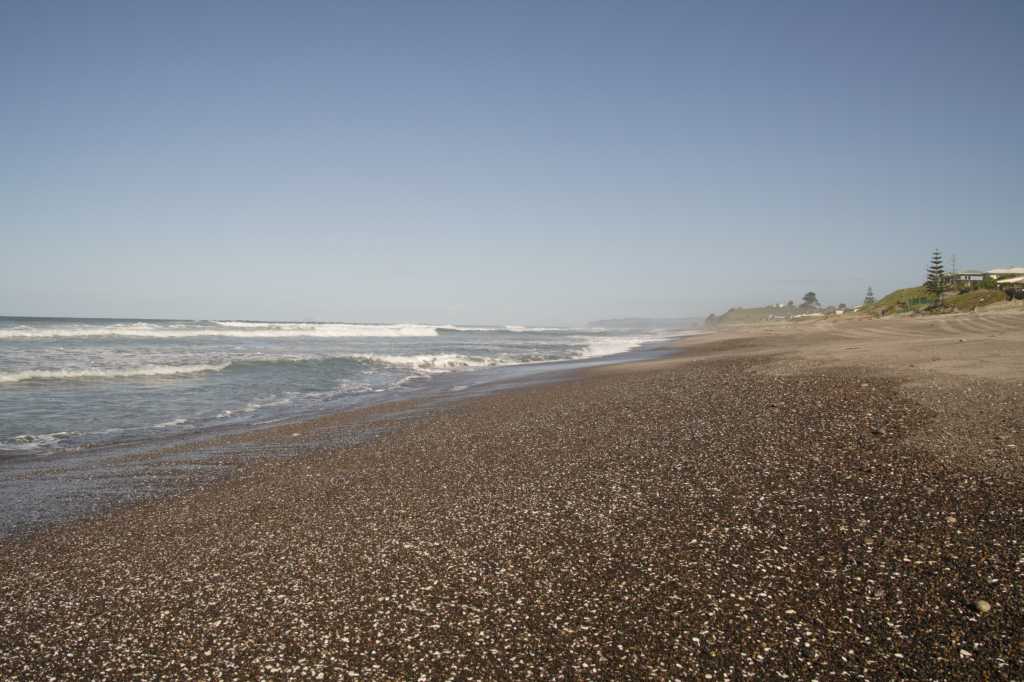
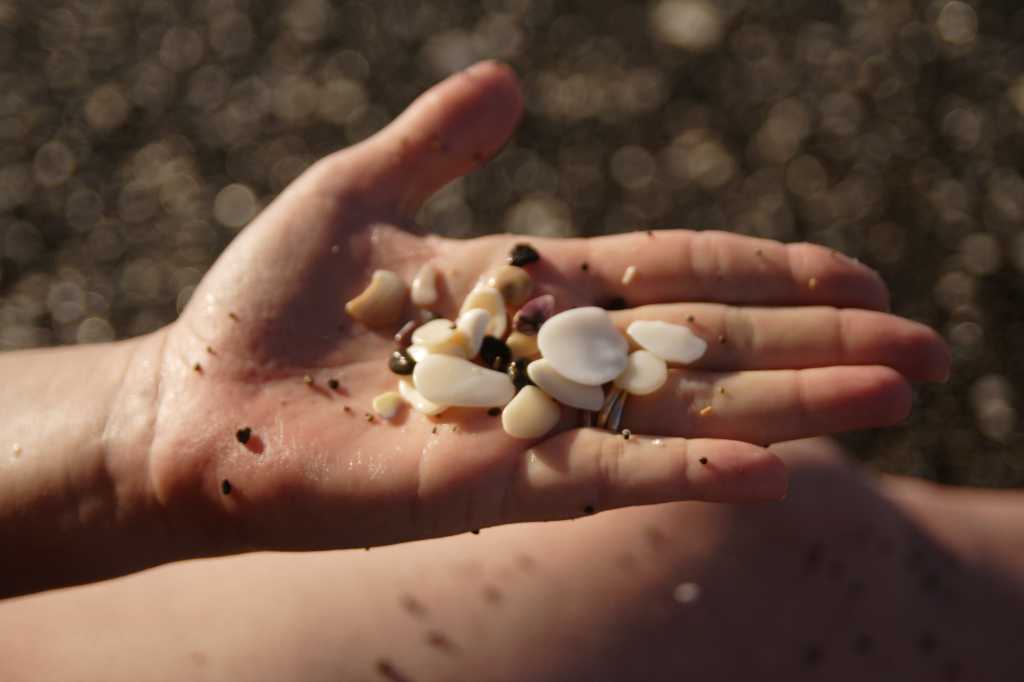
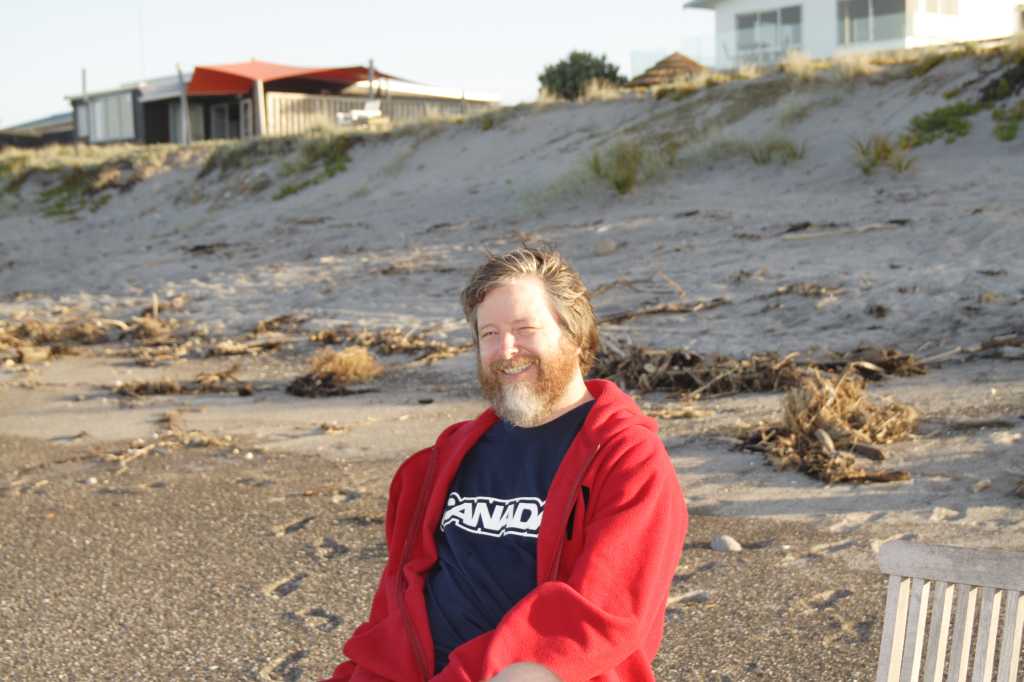
We drove back to the cottage and spent a few final hours enjoying the location. We went for a swim in the biggish waves and had a long sit on the beach catching the last of the sun. Here are a few shots.


It's Art Man! Don't you get it?


No. Wait. This must be the art ...


Sadly, once the sun had faded, we set ourselves to packing and cleaning, preparing for an early start the next morning.

Which leads us to ... Friday

Bye.

Wednesday, February 15, 2006

Spelunkers Spelunking

As mentioned earlier, we had set Monday and Wednesday as busy days. While Monday was thermal wasteland day, Wednesday was dedicated to spelunking.

The Waitomo Caves region is riddled with underground passages that are populated by a variety of unique lifeforms, the most notable being the glow worms.

Glow worms are the larval stage of some kind of fly, blah de blah de blah - the guide decided to explain this stuff underground, and his accent combined with the echoes in the cave made the whole story mostly unintelligible, and to be honest I don't care that much about the lifecycle of these bugs. I did catch the big finish of the guide's spiel, which went like this: "So what we're looking at are cannibalistic shagging maggots that crap light". A pretty good finish. He should have started with it.
We signed up for the "TumuTumu Toobing" cave trip, run by Waitomo Adventures.

The trip started an hour late, so we had a little time to check out the caving museum which has a few interesting exhibits and is certainly worth the 15 or 20 minutes it takes to walk through.

The caving adventure operators do not allow cameras, so a verbal description of our underground trip will have to suffice for those interested.

The caving adventure began aboard a mini-bus which had at one time been a Japanese kindergarden bus - I kid you not ... the interior was festooned with cheerful balloon and ferris wheel graphics, and there was a large Hello Kitty (it's a cult thing) applique on the exit door.

The ride from the ticket centre to and from the caving site was the most exciting part of the trip (the rest was interesting, but not life-threatened exciting). Saying the Waitomo Caves region is very hilly is like saying Lake Ontario is a little wet. Except for the small flats on top of each hill, there isn't a natural level spot in the entire area. Once we turned off the main paved road, it became clear that the narrow gravel road had been carved from the edge of each hill with as little effort as possible.

A small effort has been made to make it seem that there is a fence to keep the bus from slipping off the edge of each hairpin turn and rolling down the two hundred foot hill (80 degree slope anyone?) but really, is anyone comforted by a couple of t-bar snow fence rods pounded into the gravel? Our group consisted of three travellers from Isreal, two from England, one from Holland, and oursleves. Fortunately for all concerned, none of the others (including Debbie) seemed to notice that their lives hung in the balance, and our trips there and back were without incident.

A small quonset hut had been erected on one of the small flat spots at the top of a hill, and inside the eight of us plus our two guides were outfitted with snug fitting wetsuits (very slimming! I just need to figure out how to work it into my regular outfit at work) and rubber boots (gum boots for those with an English bent). We also were issued a hard hat fitted with an LED light source.

Once everyone was equipped, we set out on a moderate hike through the surrounding highlands. As I said, the quonset was erected at the top, and the cave entrance was at the bottom. We trudged through several farm fields, and I am certain if an alien were watching at that moment, he/she/it would surely have wondered at the sanity of a group of people walking through the sunny fields, past the grazing sheep, in full wetsuits.

The entrance to the cave was at the bottom of a glade of lush trees, accessed by means of a ladder passing through a narrow cleft in the rock. The opening in the rock was barely the width of a large Sturgeon, and I am surprised in hindsight that there was no mention of this in the medical questionnaire we were forced to fill out before departing.

Once through the entrance slit, the cave opened up to a chamber 10 feet high, and 6 or 8 feet wide. A small stream passed through this room and exited through a passage that was tall enough for us to walk through upright. We congregated in an large chamber until the entire party had passed into the cave, the only illumination supplied by the lights of our helmets.

In all truthfulness, I fully expected a more genteel kind of experience. I thought there would be electric lights providing broad illumination for most of the journey, with the headlamps provided to give us access to the dark caves in which resided the glow worms. This was not to be the case.

This trip was to be genuine cave walking with nothing to rely upon except the lights we carried and the experience of the guides we were provided with. Although objectively there are lots of things that can go wrong on a 1 km underground journey, our two guides (Duane and Sheldon) were very personable and so confident and comfortable that in all honesty we never got any feeling that there was any danger in what we were doing.

I won't bore you with the details of our trek through the dark cave, but suffice to say we walked out into the light at the end very happy to have made the journey. There were lots of different topologies in the cave and a few challenging stretches combined with several caves that were an easy walk, filled with glowing spots along the ceiling provided by the glow worms. All in all, I would highly recommend this attraction for anyone having moderate fitness and a tolerance for closed spaces.

Waitomo Caves area has several tour operators that offer more and less challenging tours and, again, I would higly recommend that anyone travelling to NZ visit this area.

Debbie commented as we were driving back (the 3 hour (each way) drive there and back is a whole other entry) that no such attraction could possibly survive in litigious North American market and she's absolutely correct. The opportunities for a visitor to seriously injure him/herself are numerous and no business in North America could survive the first lawsuit, waiver or no waiver.

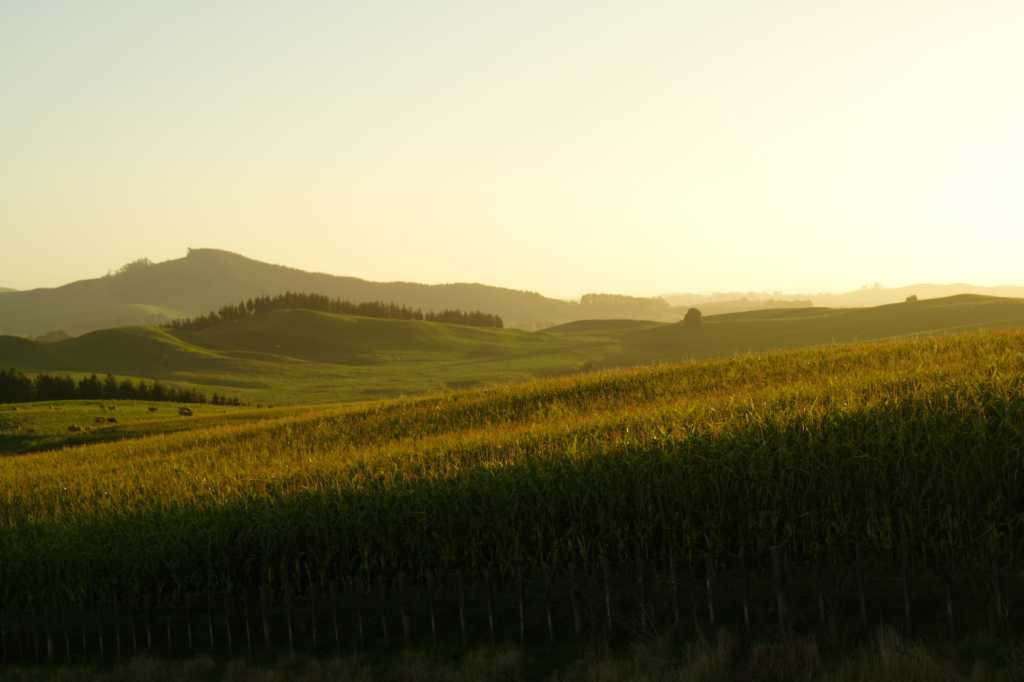
On the way back we did stop to take some pictures of a ridiculously picturesque farm scene which I will share with you now.


Until next time

Don

Tuesday, February 14, 2006

Quiet Day

Tuesday was another beautiful day at Pukehina Beach. After our experience on Friday, we were a little worried that the east coast might be a little wetter than your average cottager might like, but our fears seemed to be unfounded.

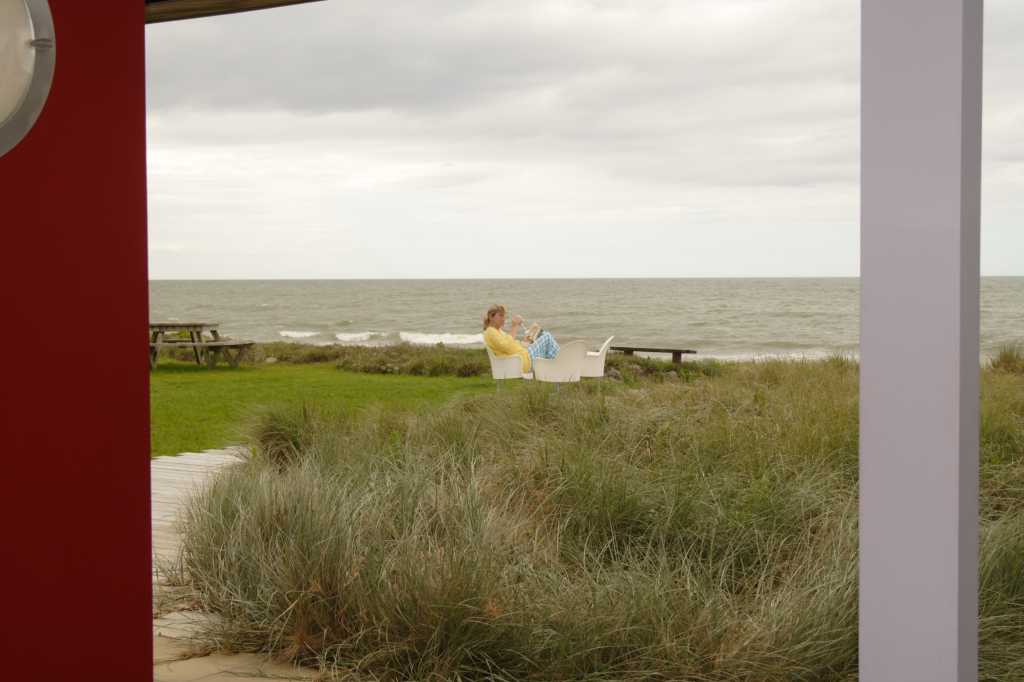
Debbie set herself up for a day of reading out front on the path to the beach. I settled into my little corner of the kitchen where the laptop was set up, back to the wall, front to the ocean. After a couple of hours of picking through pictures and waxing poetic for blog posts of days past, I packed the laptop up, kissed my bride farewell, and struck out for the wired metropolis that is Te Puke.

Te Puke was exactly as I remembered, except the internet cafe (not a cafe at all, more a 5 X 10 back room with no air circulation and 10 computer stations) was not populated by the three hyperactive children that had been my companions the last time I had been there. In blessed quiet I updated our online diary and checked e-mail. Once done, I did a little snack shopping at the grocery store across the street and then headed back to our little slice of heaven on Pukehina Beach.

We had originally planned a home cooked dinner of steak and vegetables, but when the time came to begin cooking, the Pukehina Local takeout seemed a more logical solution to our needs. We arrived just in time to catch the last deep fryer load of battered goodness. We retired back to our cottage and cruised through several episodes of Alias and several thousand calories of fatty foods.

As Tuesday was so uneventful, I'll add a few more musings on NZ life.

If you have any experience travelling in North America, you will have noticed a remarkable uniformity in the design of the bathroom fixtures in the various retail and restaurant bathrooms. This uniformity is completely absent here in NZ. I have yet to see two bathroom fixtures the same. There are a few interesting features that will interest the bathroom fixture aficionados among you (you know who you are)

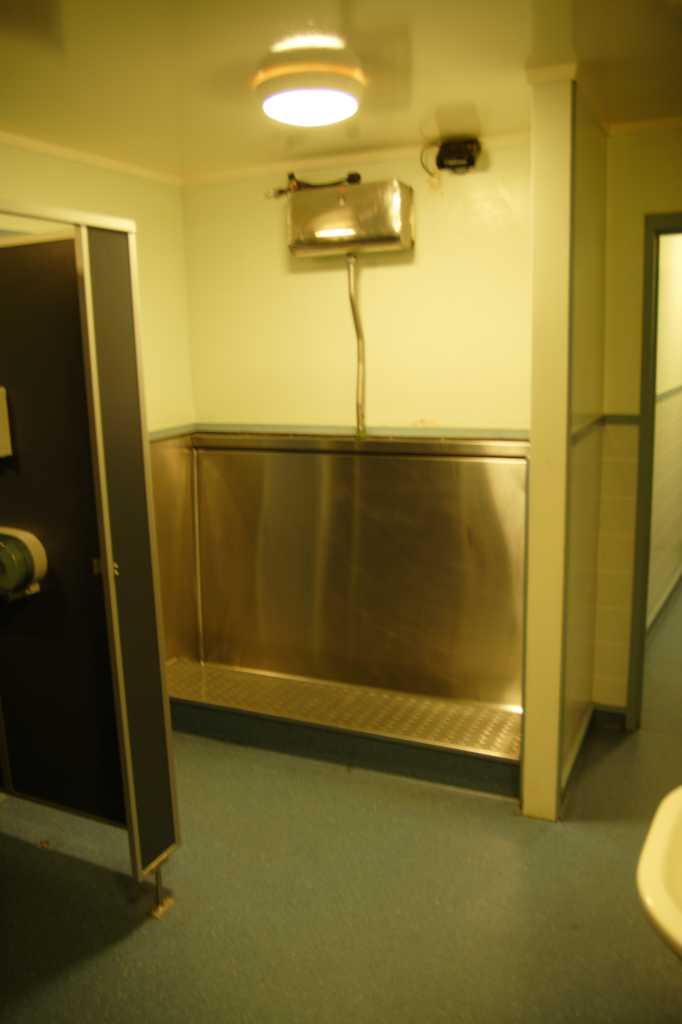
I have only run into porcelain urinals once. The vast majority of men's bathrooms have stainless steel recessed wall section with a trough at the bottom. There is usually a small sloped bit of stainless at foot level to catch the drips, but a couple had metal grates upon which you would stand that would allow any stray liquids to drop through. Here's a picture of one, because it's so interesting.


Most of the toilets in restaurants have a tank attached to the wall mounted about 2 feet above the toilet proper. There are two buttons protruding from the top of the tank, with one of them 1/2 painted with a colour. The 1/2 painted button causes a short flush and the other causes a full flush. This is a great idea for water conservation and every house should have one.
In the apartment in Auckland, the cottage at Pukehina, and in several other locations, the toilet tank has been mounted between the joists of the wall behind the toilet. There is a large pivoting tab attached to the wall that activates the flushing mechanism (but without the full/half feature).

Gas is priced at NZ$1.41 per litre which converts to about C$1.23 per litre. This price has been completely uniform in all of the places that we have visited and hasen't changed since we arrived. What is wrong with the stupid price games the Canadian fuel retailers play?

Our car is a horrible gas guzzler. We opted for a "Full Size" vehicle and were handed a Mitsubishi 380. I kid you not, my preliminary gas gallonage calculations indicate this car is getting worse gas mileage than my big ol' Chevy pickup. The latest calculation is around 6 km/litre which is about what I get in the city in the truck. That said, I am driving this one a little harder than I drive in Ontario.

The roads here, as I have said, are very twisty and winding. With a 100 kph speed limit, people including me tend to accelerate out of the corners and brake into the next one. Although this is a lot of fun (for the driver - for Debbie, read "Alarming") it has got to negatively affect fuel economy. The other thing about this car is that it has quite a bit of Ooomph when you tromp on the accelerator. Uphill or down, after a little automatic transmission downshift delay, she just rockets past whatever car or truck was moseying along in front of us. This car is also quite excellent at hugging the curves, so ... for the record, although it's a gas hog, I would have to say we've been pretty happy with it.

On the topic of driving, when we first arrived and started driving around, I tended to drive with the left wheels on the shoulder of the road. Being accustomed to having the driving controls on the left side of the vehicle, I am naturally inclined to keep the left shoulder closer (it's weird, since, with driving on the left side, it should all add up, but it doesn't - think of yourself passing a car on a 2 lane road and driving in the left lane for a while). It didn't take long (and much flinching from the passenger) for me to get accustomed to (a.k.a. concentrating on) keeping my direct forward view two or three feet from the centre line. Driving along at 100 kph on these crazy twisting roads, with large (double long - most transports have two trailers) trucks oncoming in the adjacent lane, the survival instinct joins up with 25 years of right hand roads to force the car over to the left, away from the oncoming traffic.
At first I tried to overcome this, but then I noticed that most of the Kiwi drivers are very free with the shoulders. If you pay any attention, you notice that most two lane roads here have lines painted down the centre and also on the left and right sides. They might as well not bother with the edge lines, as the drivers here just plain ignore them. Once I noticed that, I didn't feel quite as foolish for not being able to stay between the lines. The shoulders are just part of keeping as far as possible away from the oncoming traffic. Very sensible.

The grocery stores have Weight Watcher's products on the shelves, but all of the statistics printed on the nutrition labels are in metric (kilojoules instead of kilocalories). If you are calorie centric as we are, the nutrition labels aren't much help to you.

That's all for Tuesday.

Don

Monday, February 13, 2006

Off To Rotorua

We decided to be busy Monday and Wednesday this week, so it was off to Rotorua with us (about an hour's drive west).

Rotorua is a tourist destination (has been for over a century) because of the thermal water features in the area. Apparently there are some magma columns that extend up close to the surface in the region. Ground water near these columns gets superheated and then boils to the surface in some locations.

The first thing you notice upon entering the Rotorua area is the constant background smell of sulphur. After a while, we stopped smelling it, but I'm pretty sure it was everywhere and we just got used to it.

We had lunch at a "European" restaurant (Debbie had the BLT, I had the hamburger) and then headed out of town to Wai-O-Tapu, Thermal Wonderland. There are a few similar attractions in the area, some closer to, and some farther from Rotorua. We picked this one based on its middling distance and colourful brochure.

Wai-O-Tapu has a geyser that erupts every day at 10:15 am so we arrived too late to catch it. The NZ Rough Guide describes the Lady Knox Geyser as follows: "... which is ignominiously induced to perform on schedule ... a staff member pours a packet of soap flakes into the vent. Within a few minutes, the soap reduces the water's surface tension, and superheated steam and water are released in a jet ..." We didn't feel cheated to miss it.

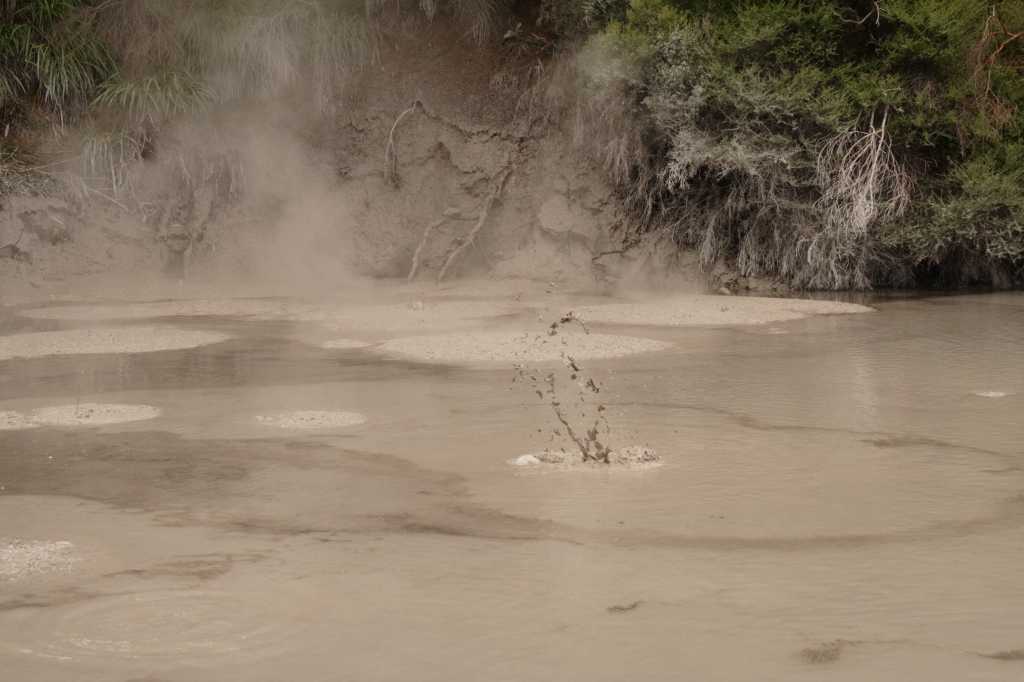
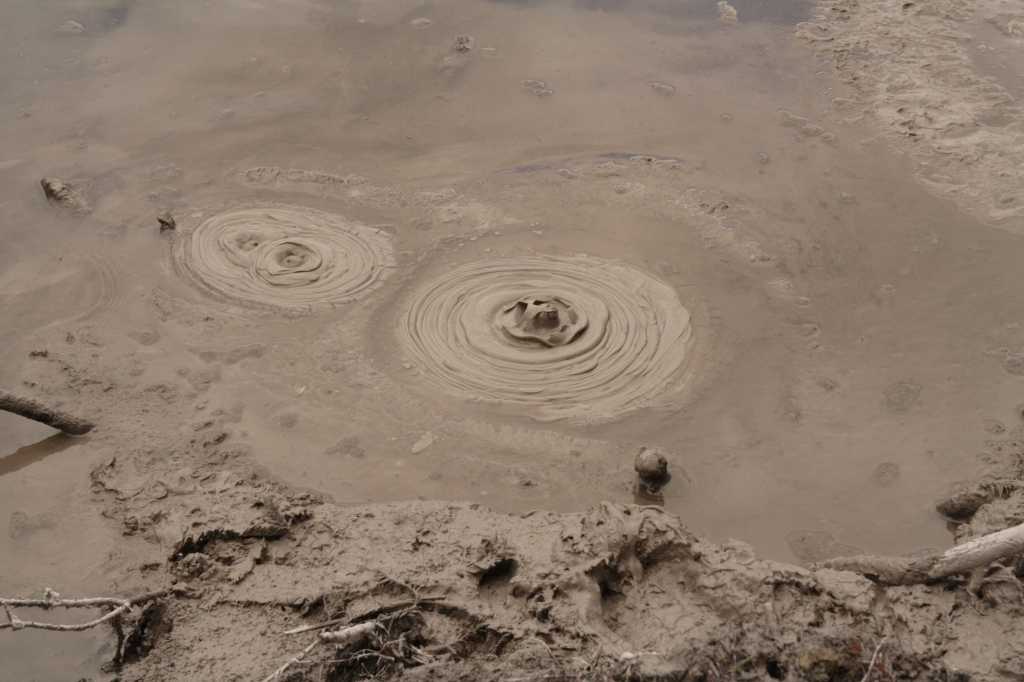
Along the road in to Wai-O-Tapu, a little side road leads you to a boiling mud pool. The steam below boils up through the mud causing the surface to plop and blort gobs of mud a few inches into the air. The mud falls back to form concentric circles which are kind of nifty.


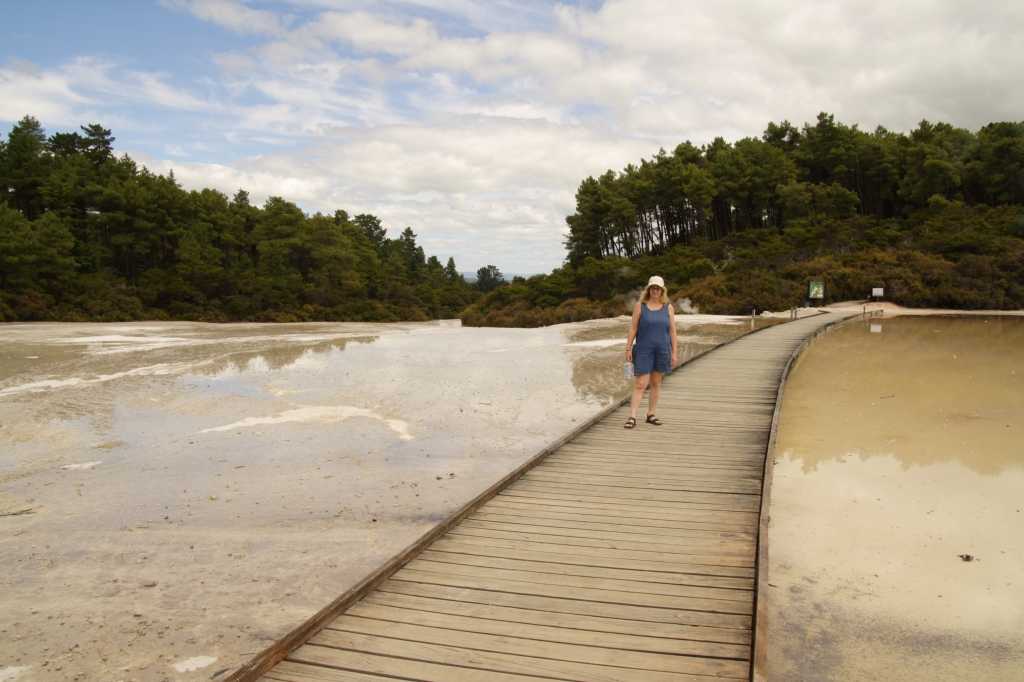
Driving a little further along, you get to the parking and main entrance. The main (and only) building is a modern structure with an enclosed snack bar and souvenir shop. Exiting the rear of that building, you embark on an hour or so long walk through a volcanic wasteland surrounded by lush forest.

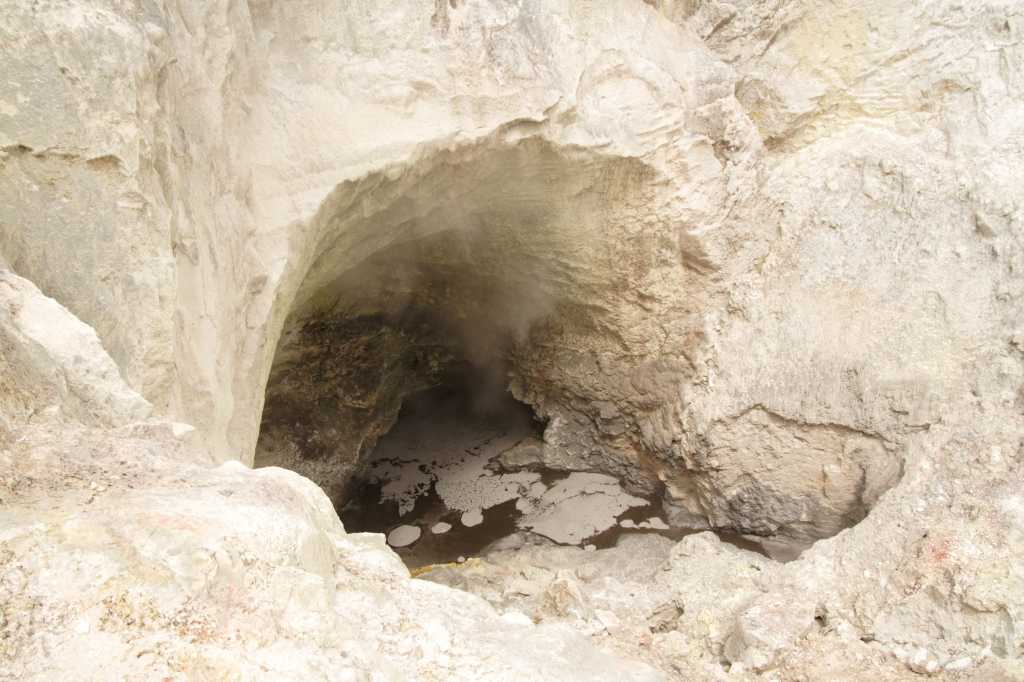
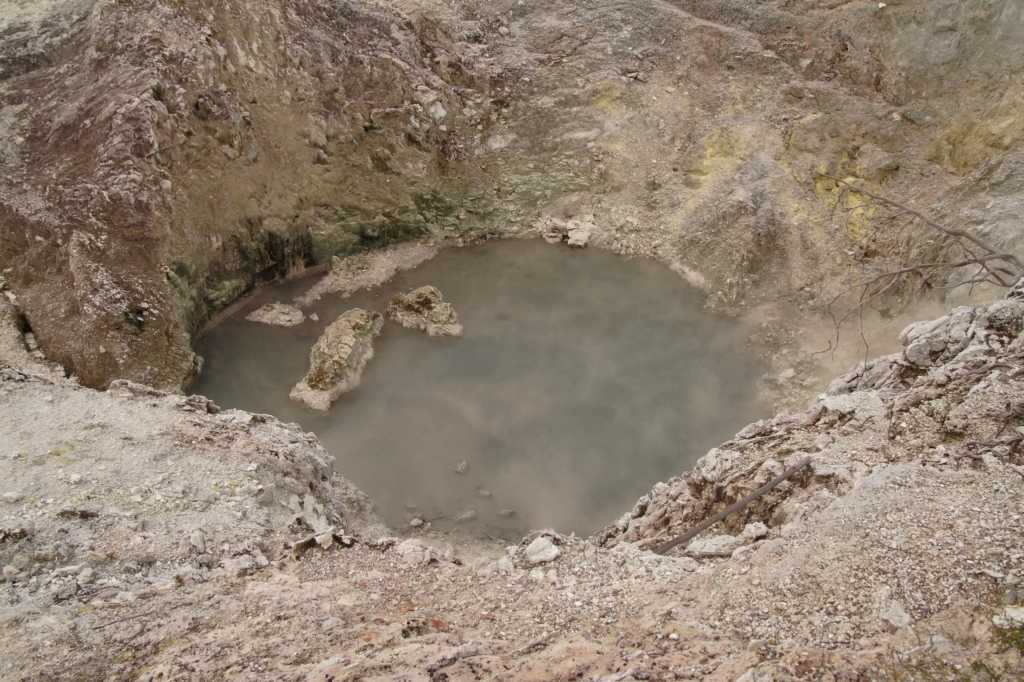
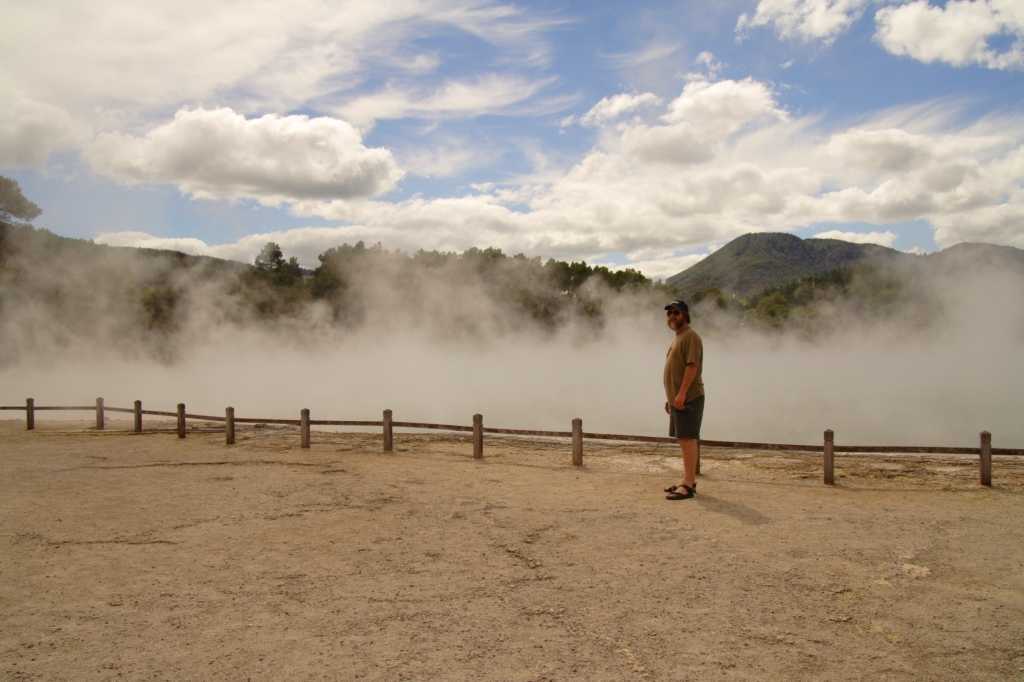
Attractions within the park consist of large deep craters with steam rising from the bottom ...


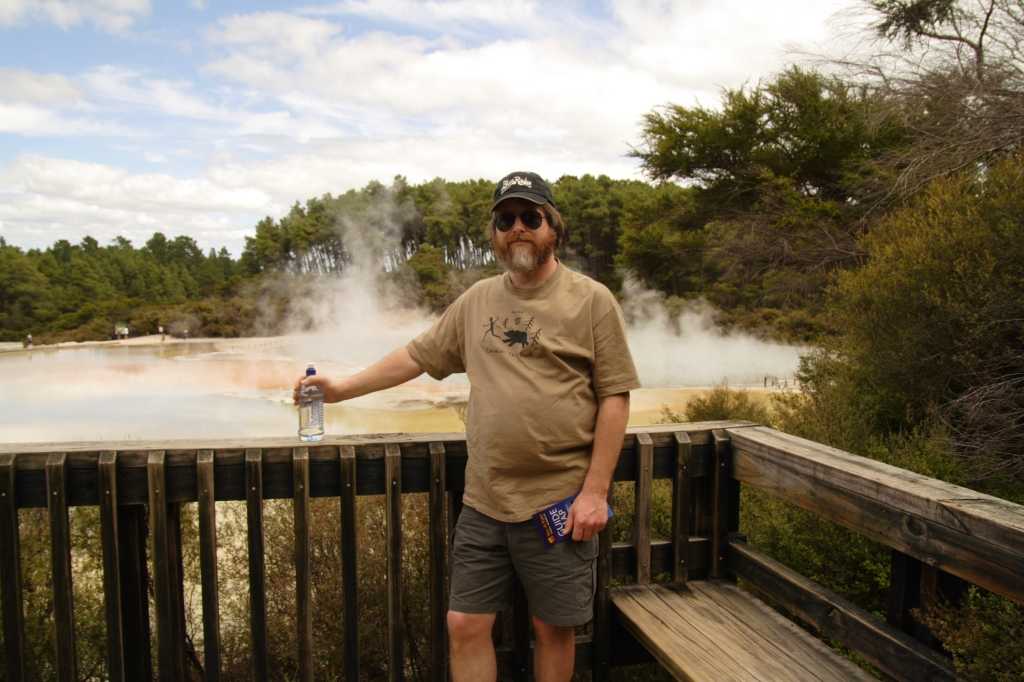
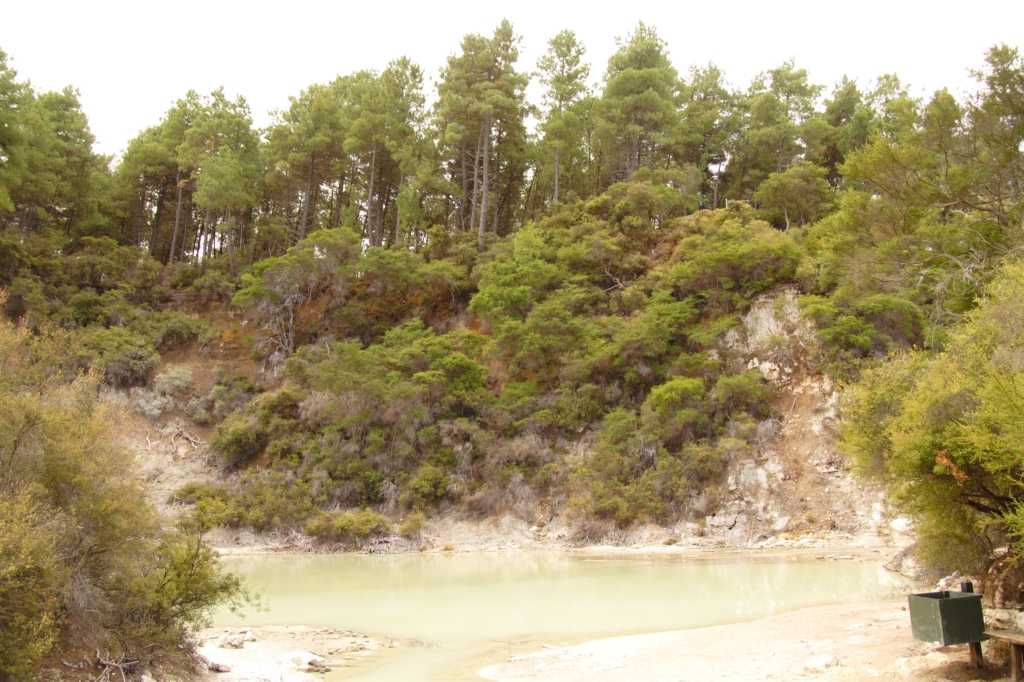
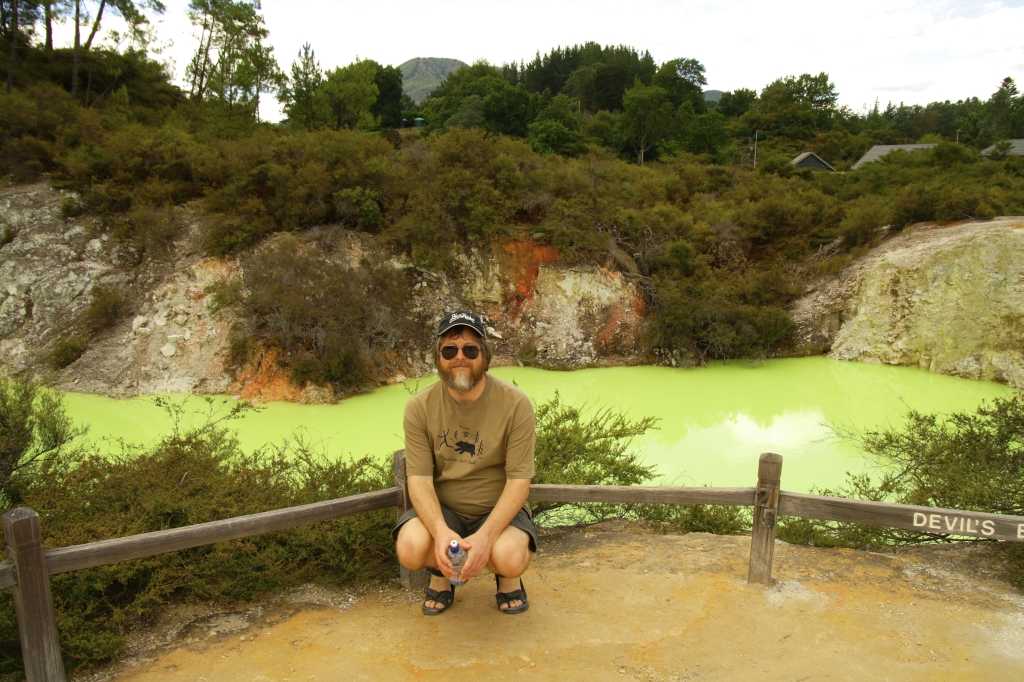
... various pools of oddly coloured water, contaminated by minerals dissolved by the heated water as it is forced up from the deep ...


(No need for those pesky safety railings here ...)


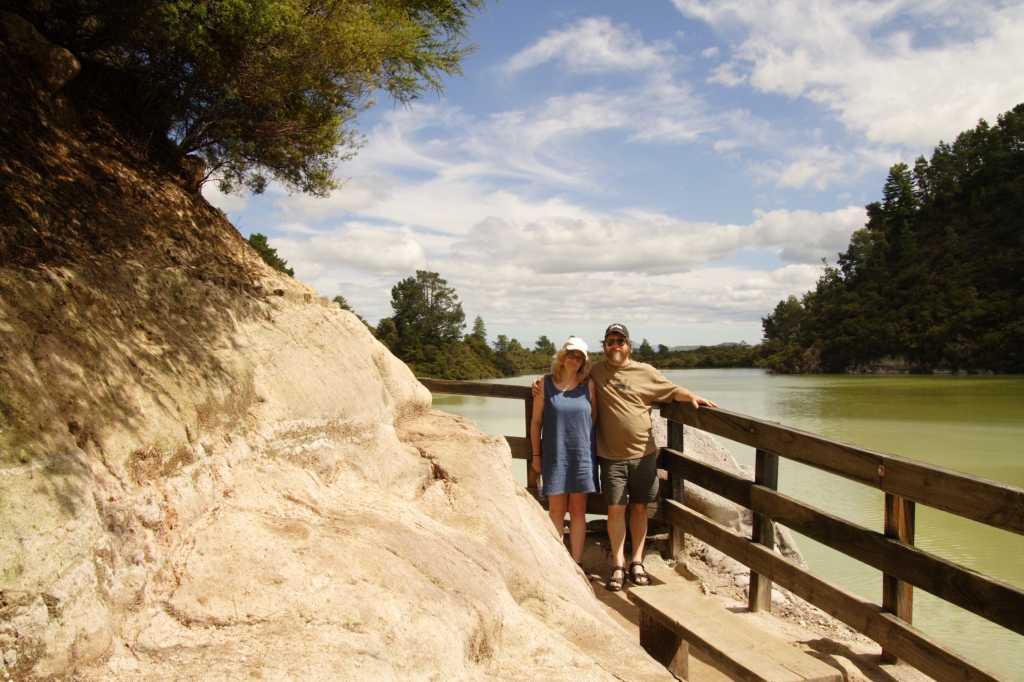
(I fiddled with the colours on this pic to see if I could get them closer to reality. The pond behind me was a bright yellowish green, but sadly all I could do was make me look kind of greenish. Oh well. )


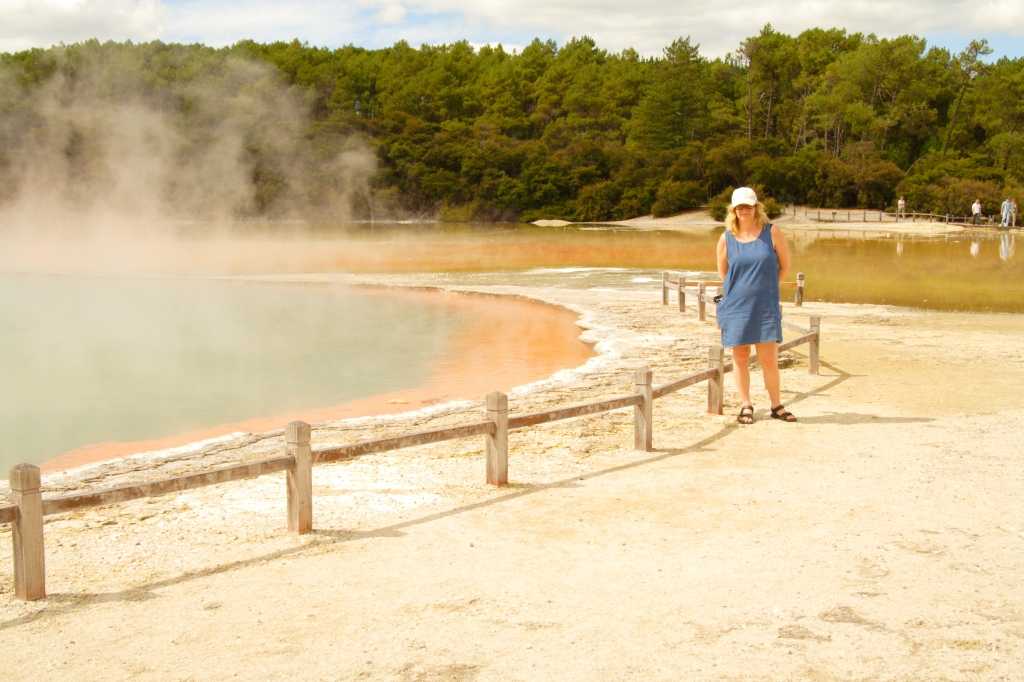
... ponds of clearer water with steam bubbling up ...

(The wind was blowing gently over the steaming pond toward us and it was like standing in a steam bath. )


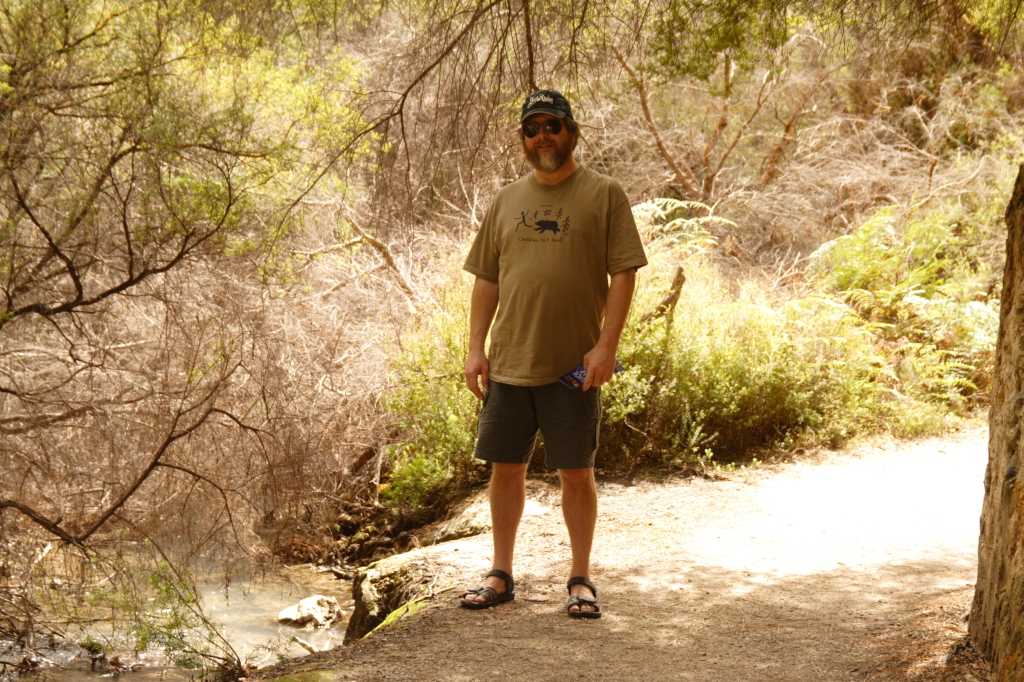
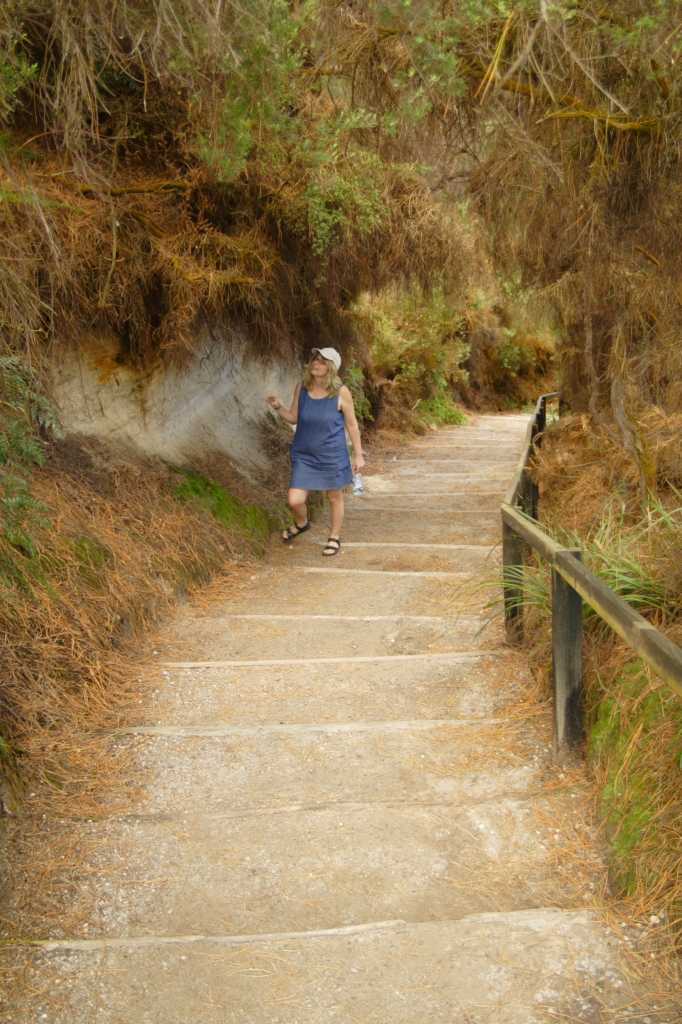
... and some beautiful forest paths.


Everything was well maintained and although the attractions were pretty low key, we had a nice time. One thing for anyone thinking of going there - the smell of sulpher is pretty powerful in most places. Debbied called it our Fart Walk and it's definitely not for the breathing challenged.

We drove back, stopping in Te Puke (teh pook-eh dammit!) to pick up some forgotten supplies.

Back at the cottage, we cooked up some dinner and finished the day watching some Alias we had brought with us.

One interesting thing for the techno-geeks out there. The DVD player (Bose) that came with the cottage has no problem playing our DVD's which are Region 1 encoded (we're in Region 4 here). Clearly regional encoding of DVDs to prevent playing in other regions has completely failed as a copy protection scheme, and the manufacturers should abandon this stupid system.

That's it for now.

Don

Lazing On A Sunday Afternoon

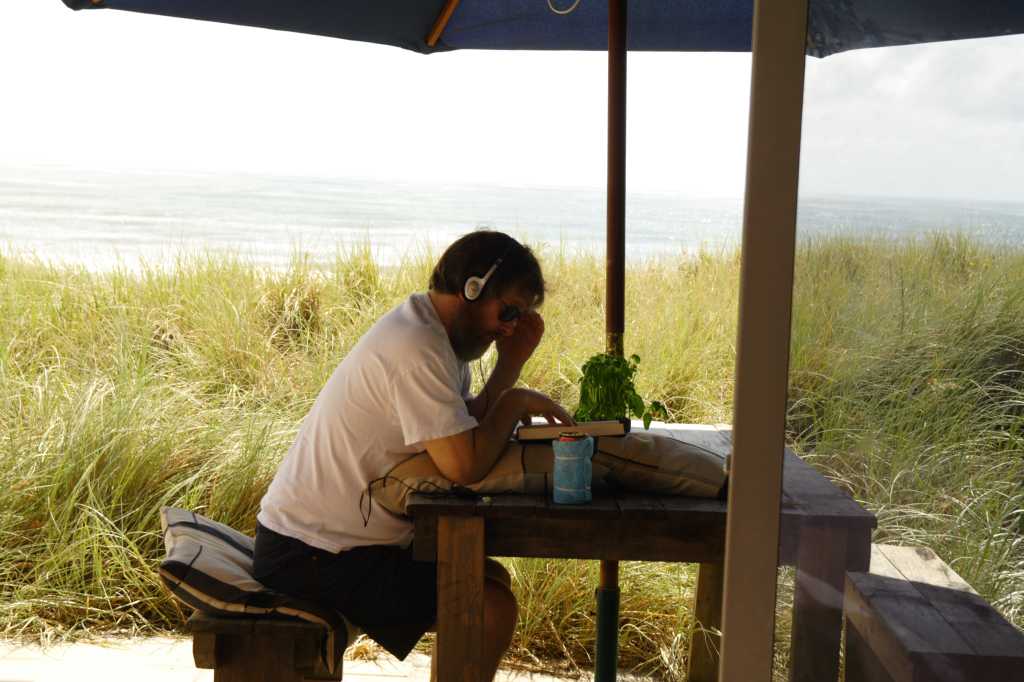
If you thought Saturday seemed like a quiet day, Sunday was even quieter. Debbie set herself up out front on the path to the beach with a book and I did the same at the picnic table (Dean (I'm too good for a middle initial now that I'm famous) Koontz's Odd Thomas for Debbie and The Da Vinci Code by Dan Brown for me).


Around 8:00 we headed down to the local pub (cleverly called the Pukehina Local) for some dinner. Our luck with kitchens continued as the dinner rush had passed and the kitchen had just closed. We had a quick drink anyway and then headed back to the cottage for a sumptuous soup and toast dinner.

To fill out this post, I'll include a few additional observations about NZ.

The asphalt roads are pretty decent here, but they incorporate a strange feature. The normal roads are a pretty coarse asphalt, and the tires generate quite a bit of road noise while rolling on it. Whenever you approach an intersection, the asphalt changes to a much smoother type, and the road noise mostly disappears. This feature is pretty uniformly applied, so it must be intentional. My best supposition is that the change in road noise is intended to alert the driver to a possible danger zone.

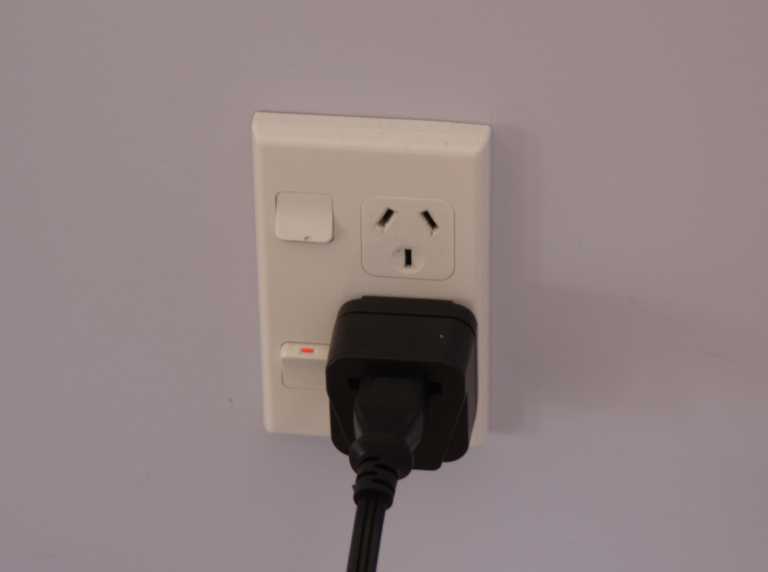
All of the outlets have their own switch. Here is a pic.


The one shown has a little light on top of the rocker to show that the switch is in the On position, but most of them don't. To add to the confusion, the standard practice is to have the top press of the toggle be the Off position, opposite to what I have come expect in Canada.

Beer shopping is an adventure in guessing. None of the North American brands have crossed the Pacific this far, so there is no brand recognition for me. In addition, alcohol content varies from 4.0 on up for regular beers and below 2.5 for what they call light beers. The only way to find a beer you like is to try a bunch of different ones. Now this might not seem like too much of a hardship, but keep in mind there are a lot of crappy beers out there, and once you've bought it, there's no going back. For the record, the best all-around beer I've found is Waikato Bitter which is available fairly widely in bottles and on tap at the locals.

As far as beer is concerned, Debbie is drinking Corona (imported from Mexico) exclusively, which is also widely available, but a premium priced brand (but she's worth it). With respect to wine, the Kiwi's are crazy about it. Every liquor outlet, no matter how small or out of the way, has a hundred or more types of wine, and even the tiny mom-and-pop hole-in-the-wall bars or restaurants have 20 or more different bottles of wine available by the glass. Debbie is doing her best to sample a good variety of local wines, and has found a few she likes.

The fast food chains are here in abundance, with McDonalds and KFC being the most prevalent though they stick to the larger centres and tourist spots. In the grocery store, there are surprisingly few recognizable brands for sale, and those that are seem to have different offerings. For example, Campbells soup is here, but none of the common types like tomato or mushroom are available by them. Instead you get Thai noodle, or Sigapore curry soups from Campbells. Weird. The local ketchup has some spice that really stands out and is too sweet. Where are you Heinz! Coke has completely overwhelmed NZ. Pepsi can be found if you really look for it, but it can be conclusively determined they lost the cola wars here.

They are mad for traffic circles. While they do take a little getting used to (Look right, dammit! Right!) they are reasonably efficient at maintaining traffic flow without the need for traffic lights (Toronto city planners? Hello? Hear this?).

I was wrong about the coin denominations. They don't have a quarter, they have a 20 cent piece. Tomayto Tomahto.

There are large cicadas here. They must be hard of hearing, as they are extremely loud and persistant.

Other than that, things are pretty comfortable and familiar for a couple of "middle aged" Canadians.

Until next update ...

Don

Settling In At Pukehina

Saturday, we slept late and then headed into Te Puke (remember, it's Teh-Pook-eh) to stock the larder and upload the previous couple of days' blog posts. The shopping available in Te Puke is strictly utilitarian. There don't seem to be any craft-y or antique-y stores that cater predominantly to the tourist trade. Most of the stores on the main street are also only open until 1:00 on Saturday. Does anyone in Canada remember the time when retailers cared a whit about having a life outside the store for themselves or their employees? I guess Wal Mart hasn't made it here yet.

We arrived in town around 1:30 (and hence missed most of the stores being open) and wandered down the main street in search of lunch. Strangely, many of the shops along the main street have heavy roll up steel doors that cover the storefront. Either Te Puke has a big history of smash and grabs, or a roll up door salesman went through town and did a bang-up job of pushing these things. I'm picturing a "Music Man" kind of scenario ... You've got trouble my friends ... Right here it Te Puke ...

The quest for lunch proved trickier than we anticipated. Aside from the stores closing, the bars and restaurants also close their kitchens between 2:00 and 5:00. We eventually found a little pub on a side street with a 5 item menu that had an open kitchen and got ourselves fed and "watered".

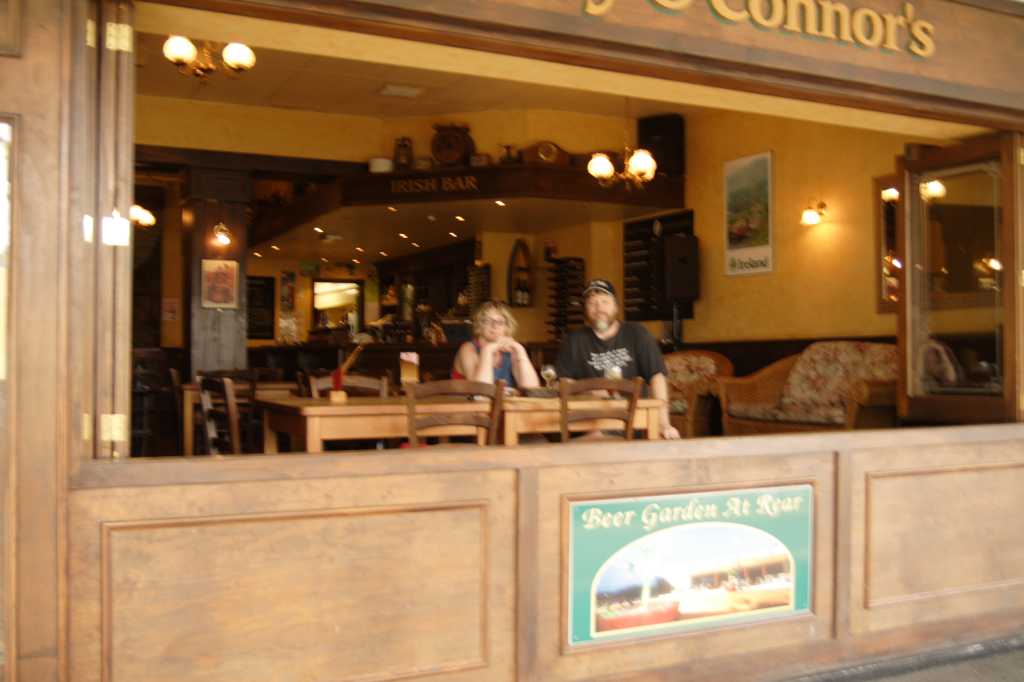
After lunch, Debbie did some grocery shopping while I did the internet cafe thing. The day was sunny and warm, and perfect for a little sit by the sidewalk, so We stopped for a sip at an Irish style pub (featuring "New England style clam chowder" - Classic Irish fare, I suppose ... as long as you don't want it between 2 and 5).


We then headed back to the cottage for a several hours of lazing about.

Since it was a quiet day, I'll just include a few pictures from around the cottage.

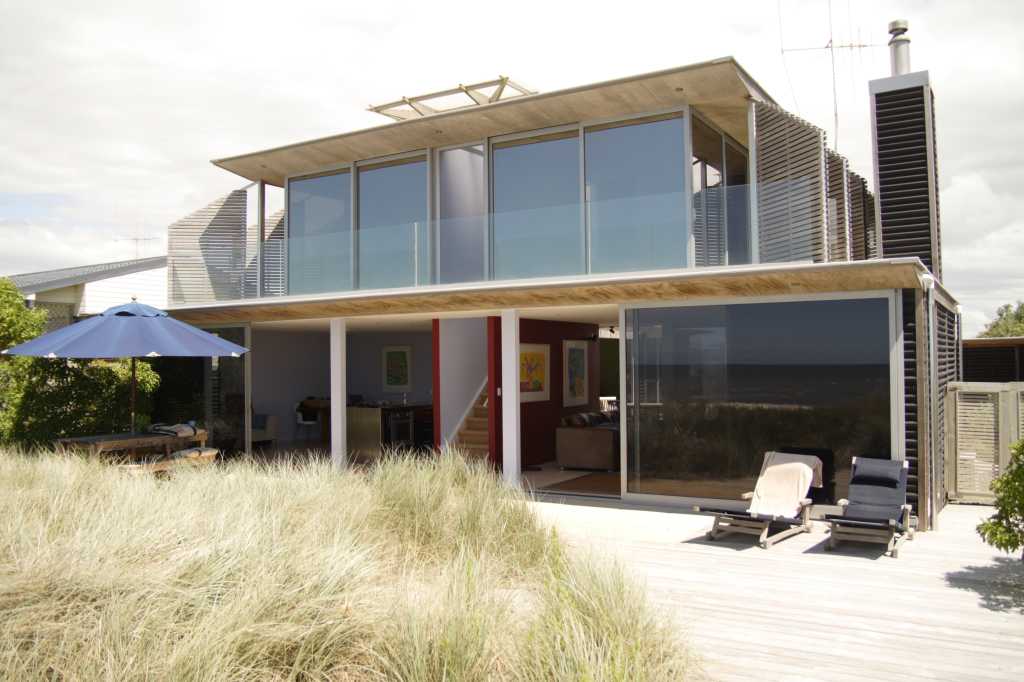
This is the view from the beach side. Notice the main floor side is mostly missing. Sliding glass doors cover the entire front of the building and they nest into each other as they are slid away.


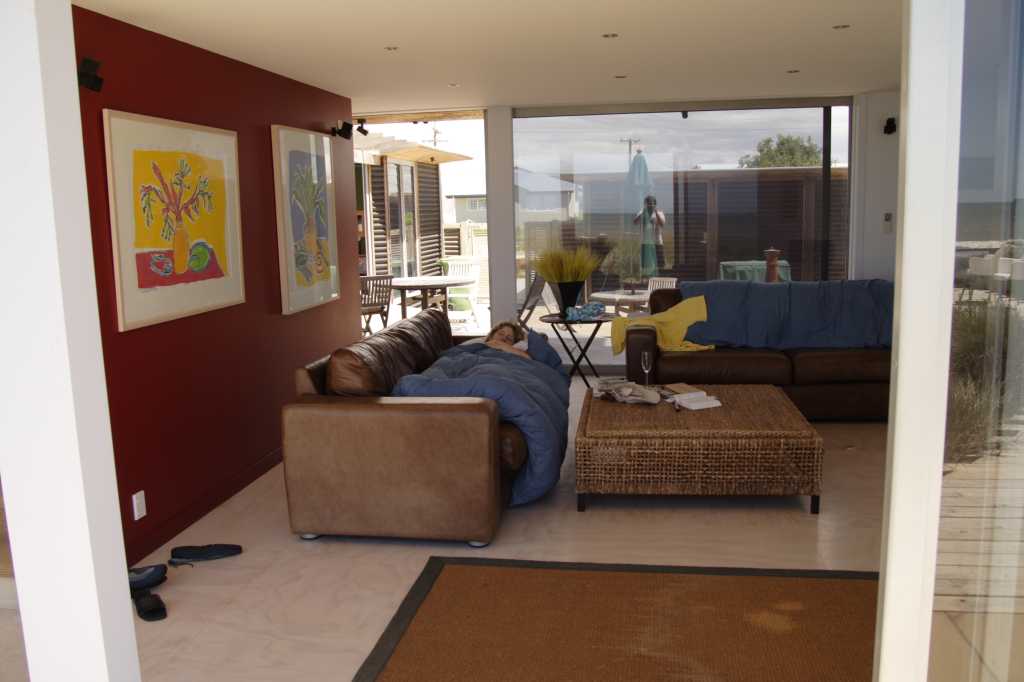
This is the view looking in through the front toward the back (street) side.


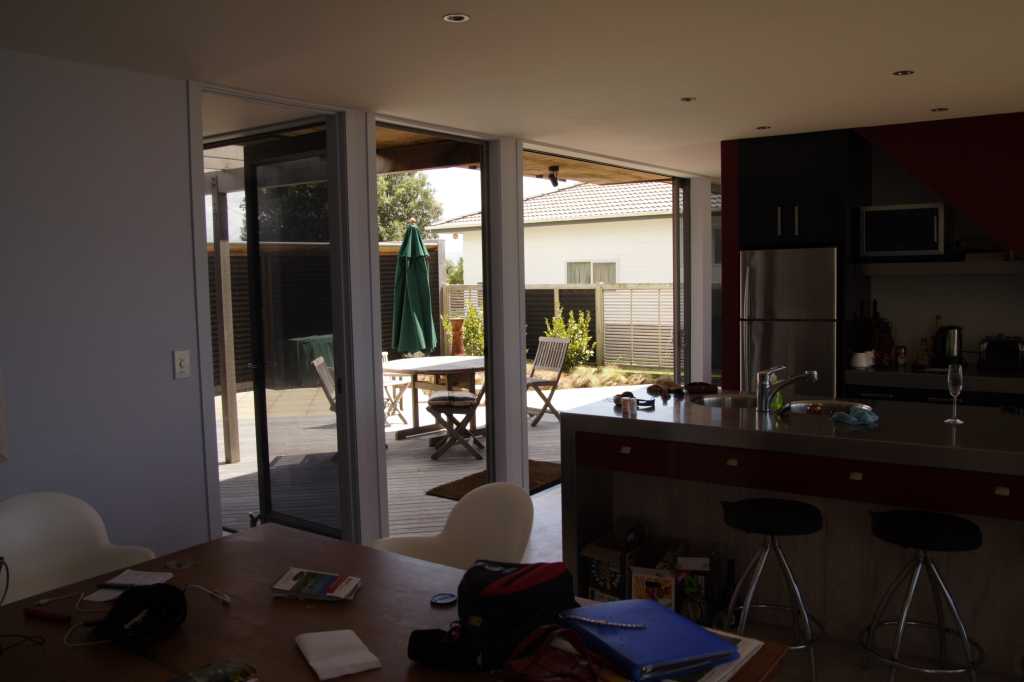
This is a view from the kitchen toward the courtyard that is on the street side (behind the windows in the above photo)


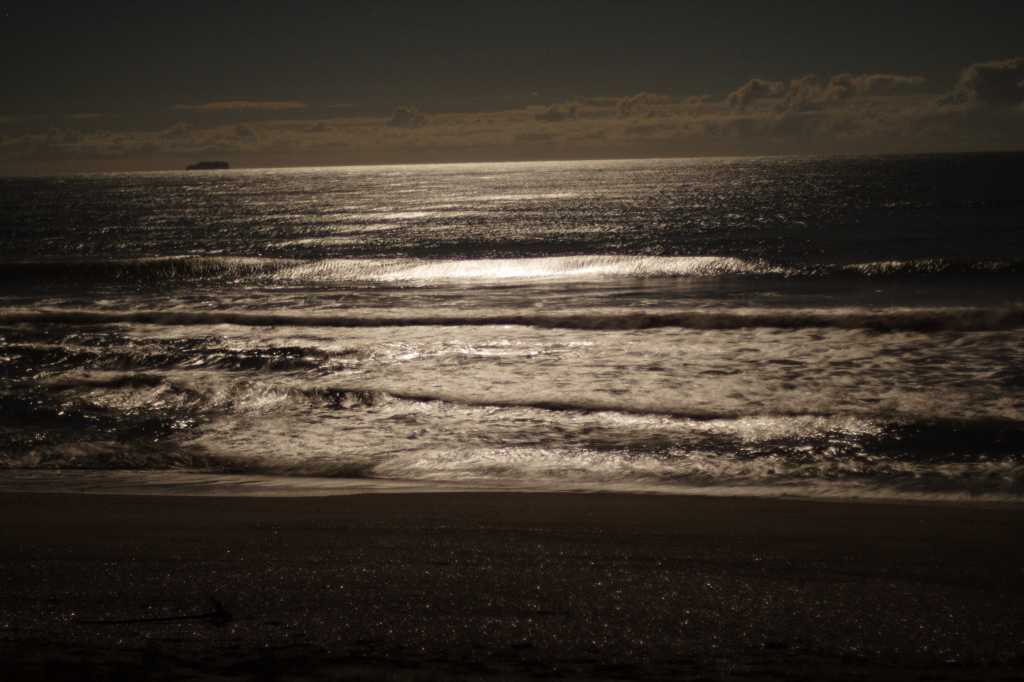
And finally, here is a shot I took out over the beach at night with the moonshine reflecting off of the waves.


... and to all a good night

Don